AI-Powered Rank Insights for Local Businesses: What You Actually See
Four search phrases come up in slightly different words but ask the same underlying question:
"ai-powered rank insights for local businesses"
"why competitors show up in ai search but i don't"
"why are my competitors getting mentioned in ai answers but we're not?"
"how to get mentioned more often than competitors in ai search"
UK local business owners are reaching for the words they know to ask about something the words do not quite fit. "AI-powered rank insights for local businesses" is borrowed from Google search vocabulary, but it points at something real. This post is for the person typing those words. It explains what the term means in practice, and what you actually see when you go and look.
What "AI-powered rank insights" actually means
The phrase is borrowed from Google. "Rank" is a Google word: the position your business holds in a list of ten blue links. People have searched for variations of "rank insights" for twenty years to mean "tell me where I sit, and where my competitors sit."
When you bolt "AI-powered" onto it, the intent becomes something different. You are not asking where you sit in a list any more. You are asking what AI assistants are saying about your business when customers ask them for recommendations. The vocabulary has not caught up with the question.
We have written about why "rank" is the wrong word for AI search in a separate post on why you can't rank on ChatGPT. The short version is: AI assistants do not produce a fixed list with positions. They generate an answer each time, naming whichever businesses their signals point at most consistently. There is no number one to climb to.
But the phrase "AI-powered rank insights" is still useful as a search term, because it is the language people reach for when they want to know what AI is saying about their business. The point of this post is not to argue with the vocabulary. The point is to describe what such an insight actually looks like when you sit down and read one.
What you actually see when you check
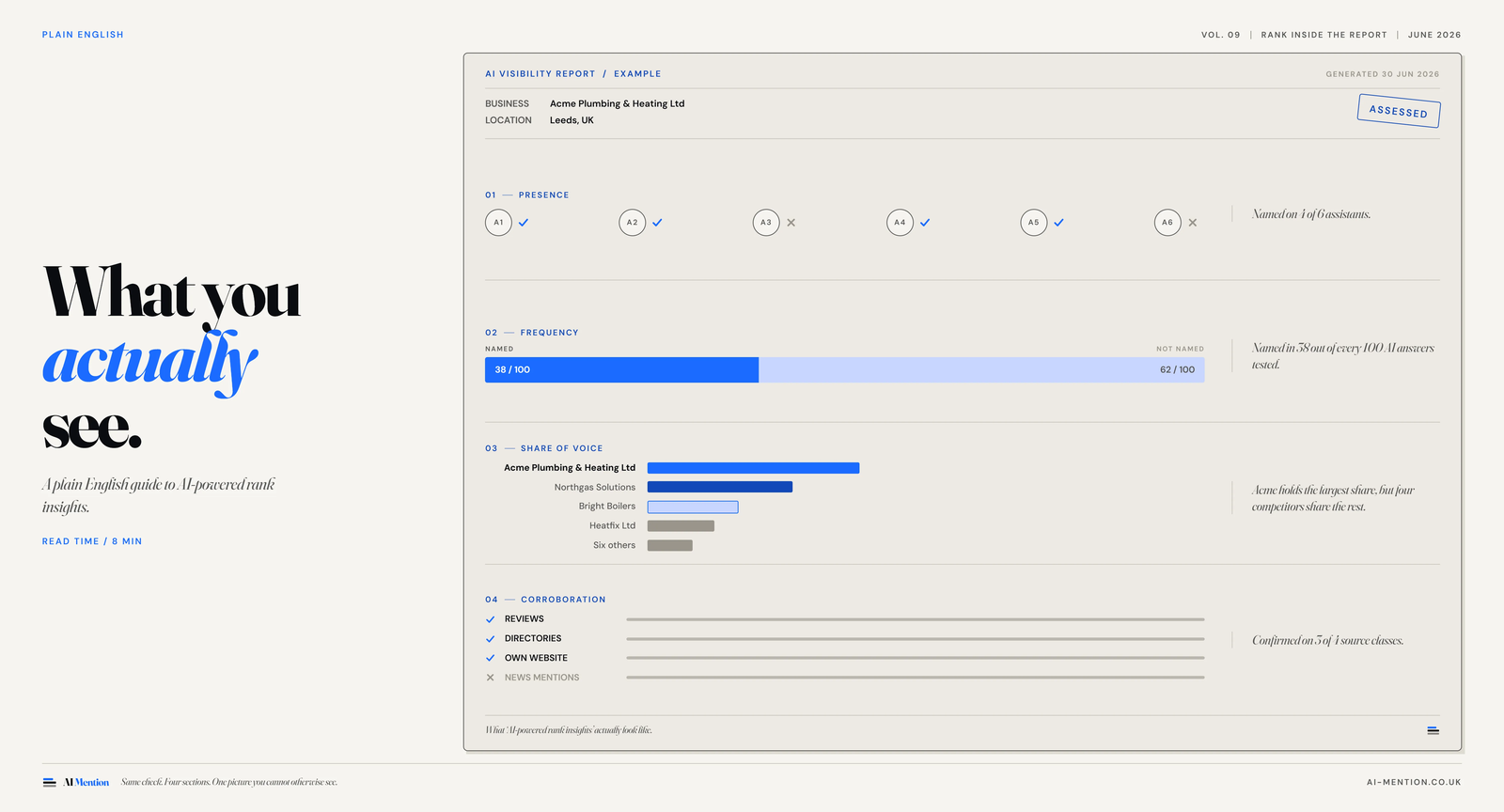
When you run an AI visibility check on a local business, you do not get a number or a position. What you get is a picture across four things.
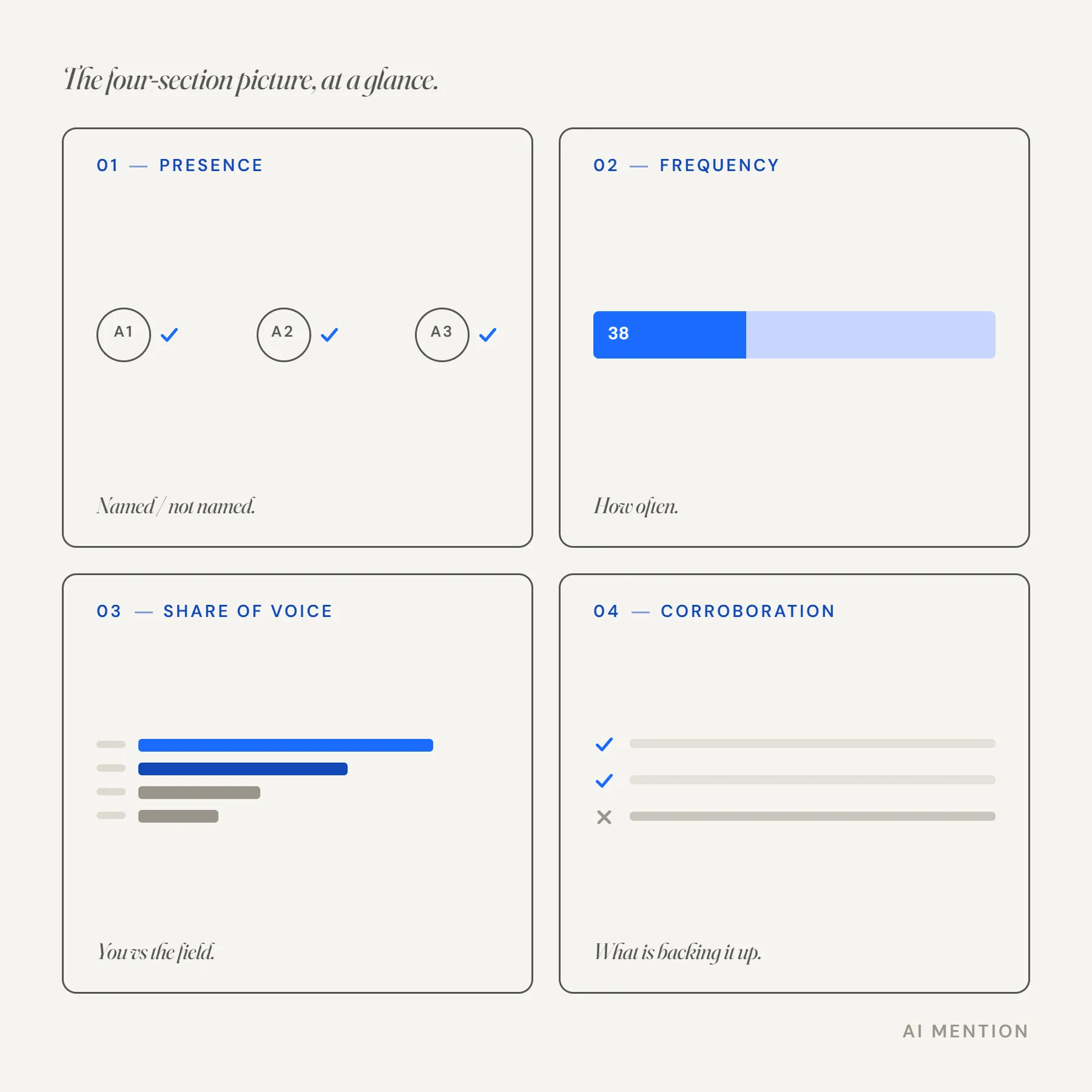
Presence. The first thing the check tells you is whether AI assistants are naming your business at all when customers ask for recommendations in your area. Sometimes the answer is yes. Sometimes the answer is no. Sometimes the answer is yes, but only on one or two of the assistants people are actually using. Presence is a yes/no/sometimes signal, not a position.
Frequency. Once you know whether you appear, the next thing the check shows is how often you appear. AI assistants do not produce the same answer twice. Ask the same question a hundred times and you will get a hundred slightly different answers, with different businesses named at different rates. Frequency is how many of those answers had your business in them. It is the closest thing AI has to a "rank" and it does not look anything like a position number. It looks like a proportion.
Share of voice. The third thing you see is how often you are named relative to the businesses around you. If twenty businesses are eligible to be named for "plumber in Leeds" and your business turns up in twelve out of a hundred answers, what is happening with the other eighty-eight? Are they spread thinly across many competitors, or is one competitor hoarding most of them? Share of voice is the picture of the whole field, not just where you sit.
Corroboration. The fourth thing is what AI is leaning on to make its decisions. AI assistants do not produce names from nothing. They cross-reference the wider web: reviews, directories, your own website, news coverage, third-party listings. The check shows you what the supporting evidence looks like for the businesses being named, and what is missing or inconsistent for the ones being skipped.
None of these four are a number on a ladder. None of them can be checked by typing a query into a search bar and reading down a list. They are patterns across many AI answers, watched over time. The "insight" in "AI-powered rank insights" is a picture of the four together, not a single position you can write down.
This is more sophisticated than a ranking. It is also less convenient. The old ladder, for all its problems, was easy to look at on a Monday morning. A picture across four patterns is genuinely harder to glance at. That is why a tool watches it for you instead of you watching it yourself.
How to read what you see
A few honest observations about how the picture tends to read in practice. None of these is a rule. They are patterns we keep seeing across the audits we run for local businesses.
If your presence is no or rare, the issue is usually that AI does not have enough material to confidently name you. You are visible to Google, you are findable on a map, but AI does not pull from the same sources. The fix is upstream of AI itself: the wider web has to corroborate you.
If your frequency is low but non-zero, AI knows you exist but you are competing with stronger candidates in the same area. Something about the competitors is making them the consistent answer. That something is usually in the corroboration picture.
If your share of voice is heavily skewed to one or two competitors, AI is over-weighting whoever has the most consistent set of signals. Catching up is a question of supplying the same signals from your side.
If your corroboration is patchy, AI is hedging. It will sometimes name you and sometimes not, because what it can confirm about you is uneven. Tightening the inconsistencies usually moves frequency and presence at the same time.
None of these are scoring rules. They are how the four sections tend to relate to one another when you read them next to each other.
What these insights do not give you
For a reader coming from the Google world, it is worth saying clearly what AI-powered rank insights do not give you.
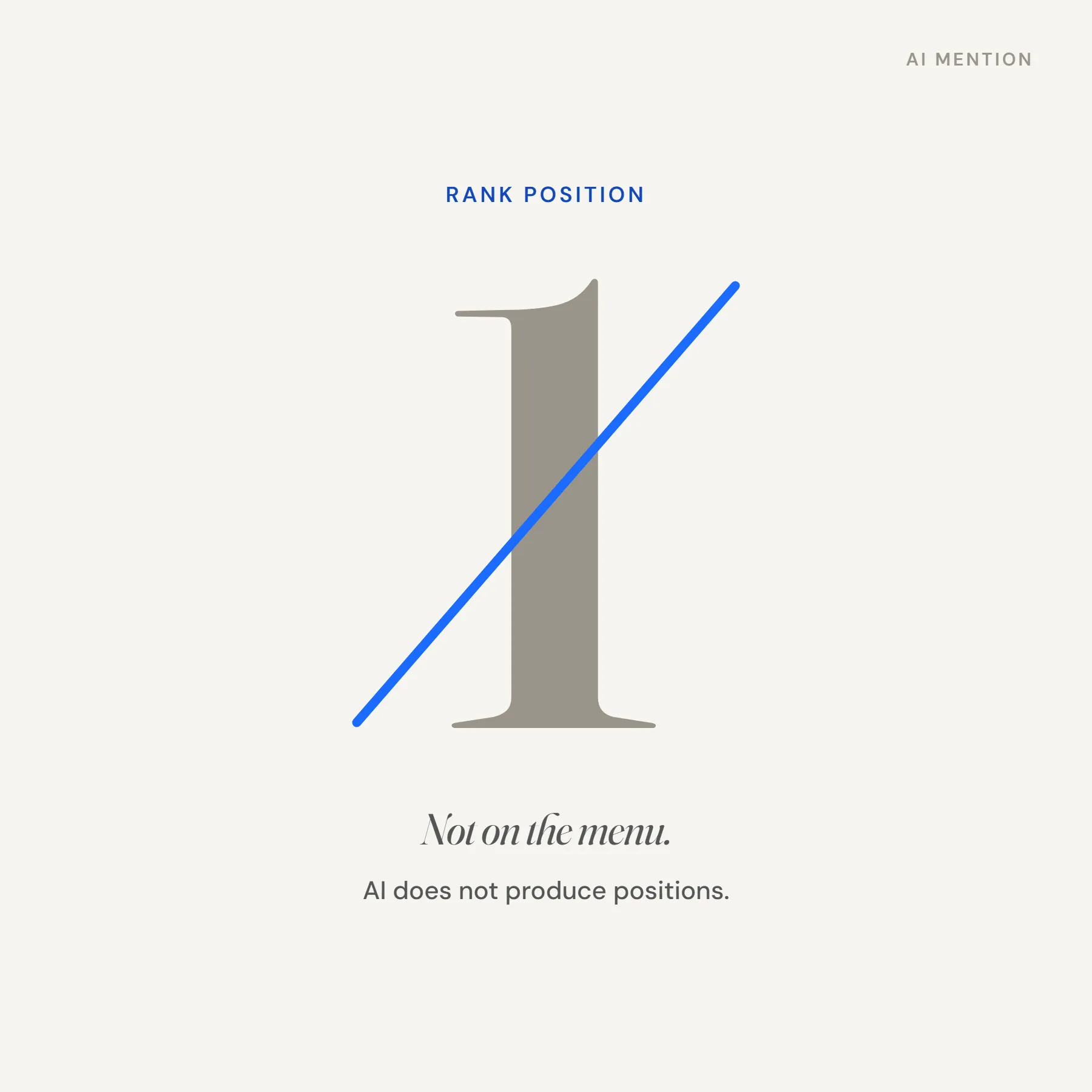
They do not give you a number from one to ten. There is no position. There is no Monday ranking versus Friday ranking.
They do not give you a list you can click through. AI answers happen inside the assistant, not on a results page.
They do not tell you "this is what will happen the next time someone asks." They tell you what has been happening, often enough to be a pattern. Forecasting individual answers is not on the menu, because AI itself does not work that way.
What they do give you is a picture you cannot otherwise see. Without this kind of check, you are guessing about how AI is treating your business. With it, you are reading something that is genuinely there.
Closing
The phrase "AI-powered rank insights for local businesses" is a search vocabulary in transition. People are reaching for the words they know to ask about something the words do not quite fit. The thing under the phrase is real and worth looking at, even if "rank" is doing a lot of work it was not designed to do.
If you want to see what your AI-powered rank insights look like for your own business, you can run a free check on AI Mention. It takes about 30 seconds. You will see the four-section picture in plain English, with no account needed. A fuller picture of how the check works is on a separate page if you want the longer read first.
How findable is your business to AI?
Run a free check on your business name and town. Discoverability score, the specific gaps AI looks at, no account needed.
Check my AI discoverability