Why You Can't Rank on ChatGPT (And What Matters Instead)
Four queries started appearing in our UK Google Search Console data in mid-June 2026. The phrasing is different each time. The underlying question is the same.
"why competitors show up in ai search but i don't"
"why are my competitors getting mentioned in ai answers but we're not?"
"why some businesses appear more repeatedly in ai answers"
"how to get mentioned more often than competitors in ai search"
Four phrasings, one underlying confusion. People are still using the ranking mental model to think about something that doesn't rank.
The instinct is fair. For 25 years, the way to think about whether your business was visible online was to ask "where do I come on Google?" The number, the position, the page. Ranking has been the vocabulary. AI search has broken the vocabulary.
How ranking worked
If you have run a business in the UK for any length of time, you have lived inside the ranking model whether you wanted to or not.
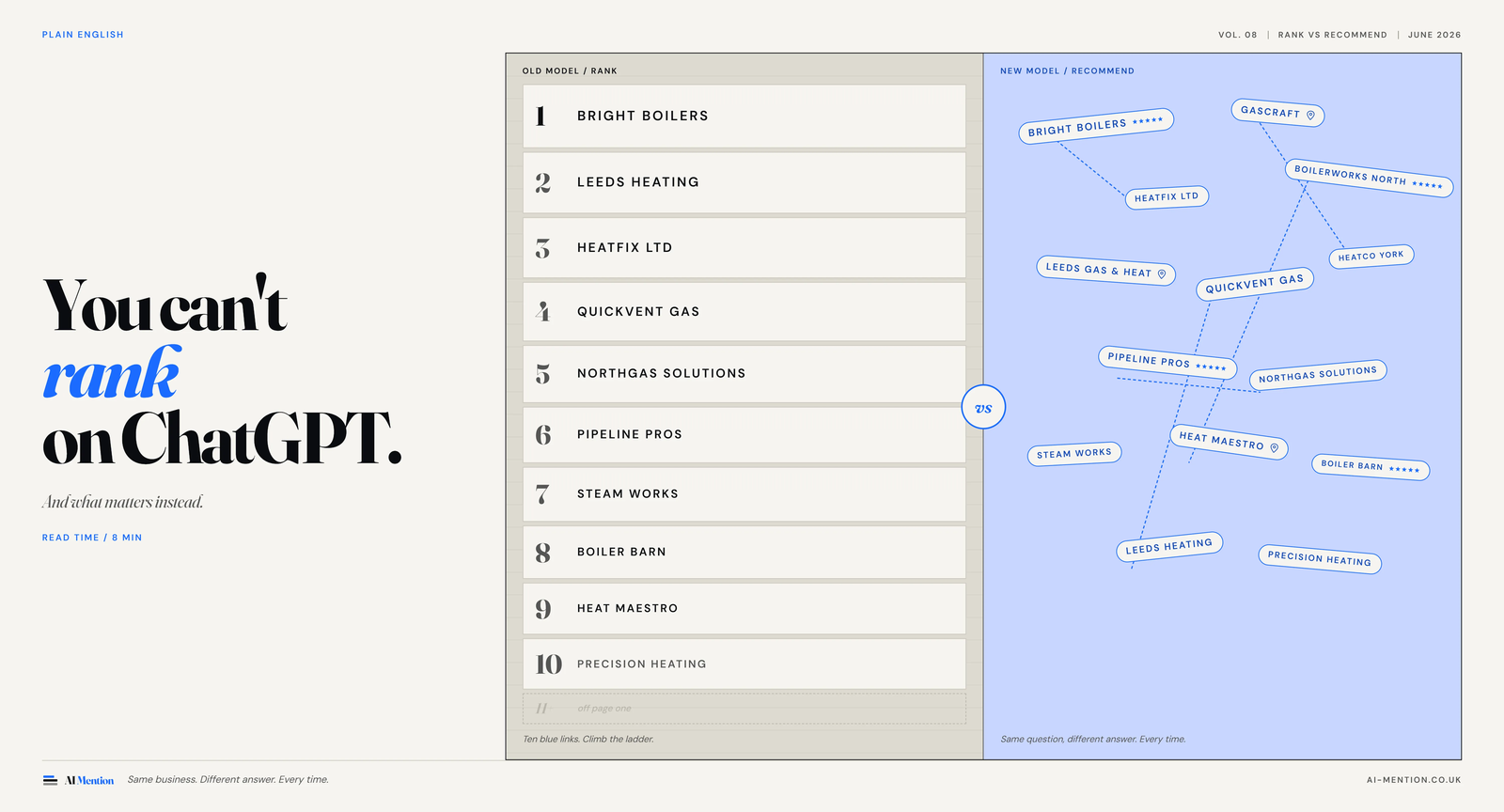
Google's search results page is a ladder. Ten blue links. Position one wins. Position ten is the bottom of the ladder. Position eleven is the bottom of the next ladder, the one nobody clicks through to. The number meant something, and the number was stable. You could check it on Monday, check it on Friday, and broadly know where you stood. If you slipped from position three to position five, you had a problem to solve. If you climbed from position eight to position four, something you did was working.
The whole optimisation game built on this was clear. Climb the ladder. Stay on page one. Don't let the competitor pass you.
It wasn't always pleasant work. But it was legible. You knew the rules.
That model is still alive for the parts of search that still rank. Google itself still ranks. Google Business Profile still ranks. The Map Pack still ranks. The mental model is not wrong everywhere.
It is wrong inside AI assistants.
Why AI doesn't rank
The first thing to notice about an AI assistant is that you cannot find a ladder anywhere in it.
Ask one of the major AI assistants for a plumber in Leeds on Tuesday morning, and it might recommend three businesses by name. Ask the same assistant the same question on Tuesday afternoon, from the same city, on the same device, and you may get three different businesses. Or two of the same and one new one. Or the same three in a different order.
Ask again on Wednesday. Different again.
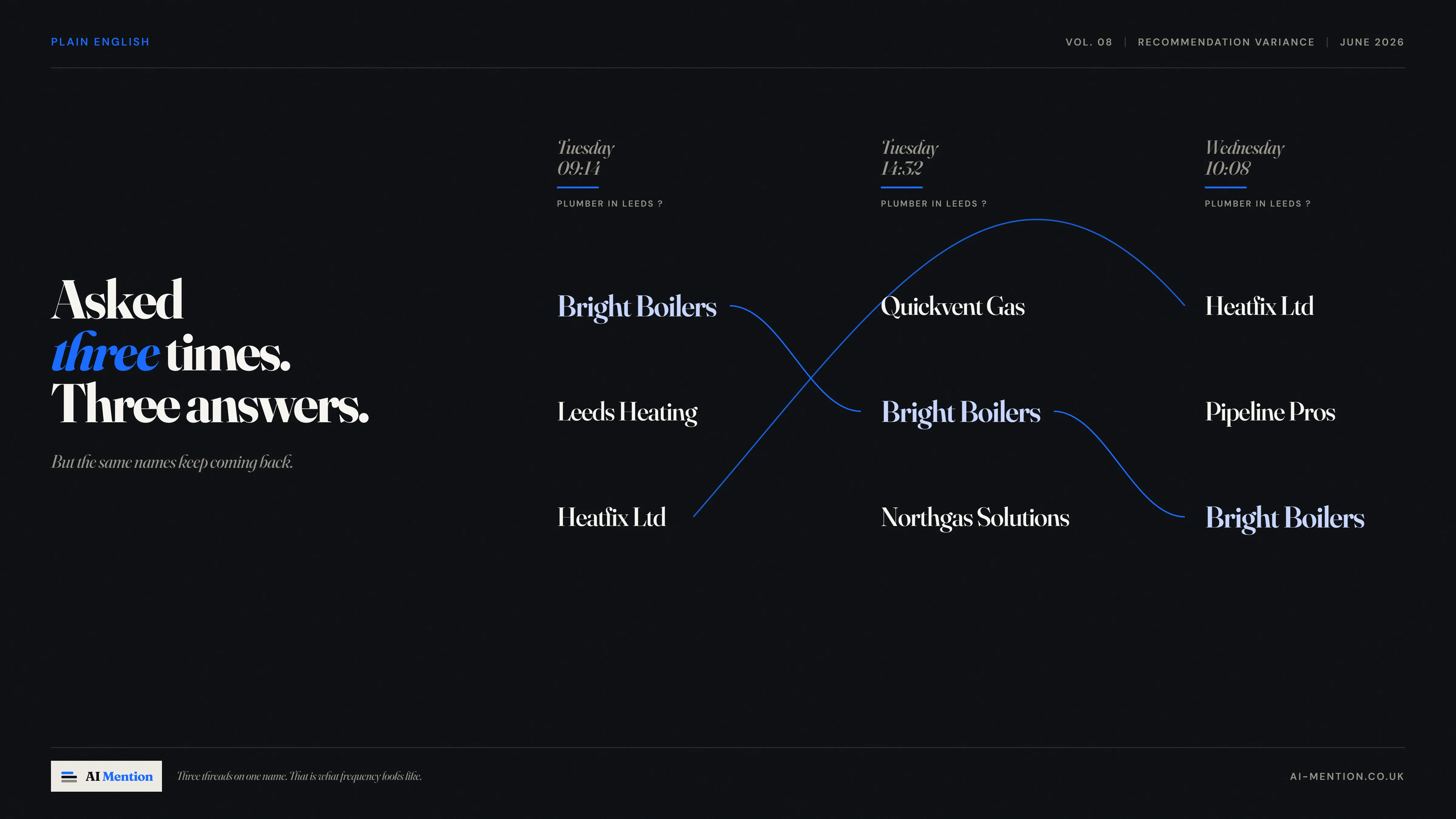
This is not a glitch. It is the design. AI assistants do not maintain a fixed list of "best plumbers in Leeds" that gets updated like a high street directory. Every time the question is asked, the answer is generated. There is no position one to climb to. There is no page one to stay on. There is no number that goes up or down for you to track week on week.
What you get instead is a series of recommendation events. Each time someone asks, an answer is produced. Sometimes you are in the answer. Sometimes you are not. Sometimes the competitor is. Sometimes neither of you. The question is not "where do I come in the list?" The question is "how often am I getting named at all?"
This is the move people are quietly making in the search bar without realising it. The queries we are seeing in our data do not ask about position. They ask about frequency ("more repeatedly"), they ask about presence ("show up"), they ask about consistency across platforms ("getting mentioned in AI answers but we're not"). Recommendation-shaped questions wearing ranking-shaped language.
What AI does instead
If ranking is the wrong frame, the right frame is recommendation. A few things matter here, and they are different to what mattered in the old model.
Frequency. How often does an AI assistant name your business across many repeated, varied queries from real-shaped customers? Not whether you appear once. Whether you appear consistently when the same general intent is being expressed in different words.
Consistency. When you do appear, are the major assistants saying broadly the same thing about you? Or is one telling people you are a national chain, another saying you are a one-person operation, and a third hedging? Inconsistency is a signal to AI that you may not be a stable, real entity worth recommending.
Share of voice. Of all the businesses an AI is willing to name for "plumber in Leeds", what fraction of the recommendations are you? Position is not measured. Share is.
Corroboration. AI assistants do not produce names from nothing. They pull on the wider web to confirm what they say. Whether your name is supported by reviews, directories, your own site, news mentions, third-party listings, and how consistently those agree, matters more than where you happen to rank in any single search.
None of these are positions. None of them have a "1" or a "10" attached to them. None of them can be checked the way you used to check a Google ranking, by typing in a query and seeing where you sat. They are patterns across many AI answers, watched over time, not single results.
This is more sophisticated than ranking. It is also less convenient. The old ladder, for all its problems, was easy to look at. The new picture is genuinely harder to see without something watching for you. We have written a little about the shift from rank to recommendation here, and about how this works in practice for the businesses we look at.
Why this changes the questions you should ask
Hold the four opening queries up against this frame. Each one becomes a better question when it stops asking for a ranking.
"Why does my competitor show up?" becomes "How often does my competitor get named across the platforms my customers are actually using?" That is a question about frequency. It has a real answer.
"Why am I not mentioned?" becomes "What does AI have available to confirm I exist, and is it consistent?" That is a question about corroboration. It has a real answer too.
"Why do some businesses appear more repeatedly?" becomes "What makes their frequency stable across queries when mine is not?" That is a question about signal density across the wider web, and it points at things you can actually influence.
"How do I get mentioned more often?" becomes "What corroborating signals could I be supplying that I am not, and where would I supply them?" That one is the closest to actionable, but it still does not have a ranking-shaped answer. It has a recommendation-shaped answer.
The point is not that the new questions are harder. The point is that they are the right questions. Asking the old ones inside AI search produces frustration. Asking the new ones produces a path forward.
Closing
You cannot answer any of these new questions by yourself with the tools you used to use. Google Search Console tells you what Google knows about you. It does not tell you what AI assistants are saying. AI assistants do not publish a leaderboard. There is no AI equivalent of refreshing the search results page to check your position. The thing you would want to watch is not visible from where you can stand on your own.
That is the gap a tracker fills.
If you want to see what AI is currently saying about your business, you can run a free AI visibility check on AI Mention. It takes about 30 seconds. No account needed. You will see the gap between what Google knows about you and what AI knows about you, in plain English.
How findable is your business to AI?
Run a free check on your business name and town. Discoverability score, the specific gaps AI looks at, no account needed.
Check my AI discoverability