How To Get Recommended More Often By AI Search
"How to show up on AI search" started appearing in UK Google search data in June 2026. So did "how to get mentioned more often than competitors in AI search". A year ago those queries did not exist. Now they do, and they have intent behind them: small business owners who already know AI is recommending businesses to their customers, and want to know what to do about it.
This post answers that, based on what we keep seeing when we run AI visibility audits. Not theory. Pattern. And one of the patterns is contrarian: a lot of the advice circulating about AI search points at the wrong things.
There is no on/off switch
AI recommendation is not a ranking with a number-one slot and a number-two slot. There is no inbox you can pay your way into. AI picks the business whose signals cross-reference most cleanly, then names whoever the signals point at most consistently.
The job is not to rank. The job is to make every signal AI looks at strong enough that any one of them could carry you, then repeat that across enough places that AI sees the same answer no matter where it looks.
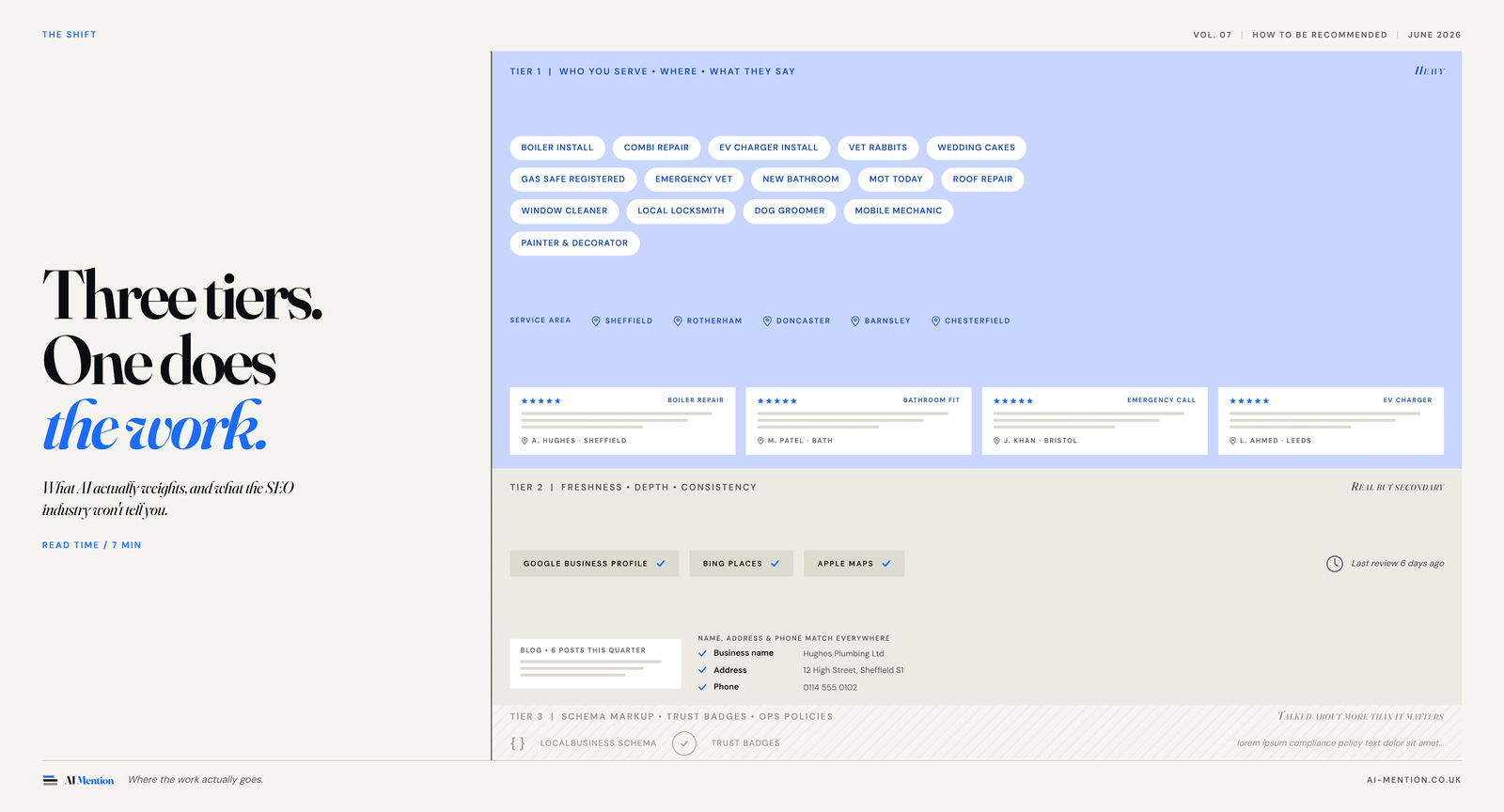
Three tiers, not a flat checklist
When we look at what AI returns to when it explains its own picks, the same shape emerges across the audits we run for UK plumbers, vets, bakeries, tradespeople and small agencies. Not a flat list of signals. Three tiers, and they do not get equal weight.
Tier 1 - Who you serve, where, and what they say about you
This is where most of the work pays. The signals here are the ones AI keeps coming back to: the reputation of your business, the area you actually serve, and how clearly you have positioned yourself as the answer to the specific thing being asked.
Reviews sit at the top of this tier. Trustpilot's UK growth research (February 2025, 2,000 UK consumers and 600 UK SMEs) put it bluntly: "consumers ranked independent review platforms as the single most important source of information when making purchase decisions (84%), rating them as more important than social circles (83%)". The web AI is trained on is largely the web UK consumers read. The pattern survives.
Local relevance sits alongside it. A business whose town is named in its reviews, on its homepage, in its Google Business Profile, and in the way other sites link to it, is a business AI can confidently name in a town-specific query. A business that has scattered "we serve all of Surrey" across its site without specifics has given AI nothing to confirm.
And then there is the specific service. AI is being asked specific things. "Best vet for rabbits in Bath". "Boiler installer in Sheffield, gas safe". The businesses that get named are the ones whose websites and listings answer the specific version of the question, not the generic one. A page that says "we install boilers" loses to a page that says "we install combi and system boilers across Sheffield, gas safe registered, with same-day callout".
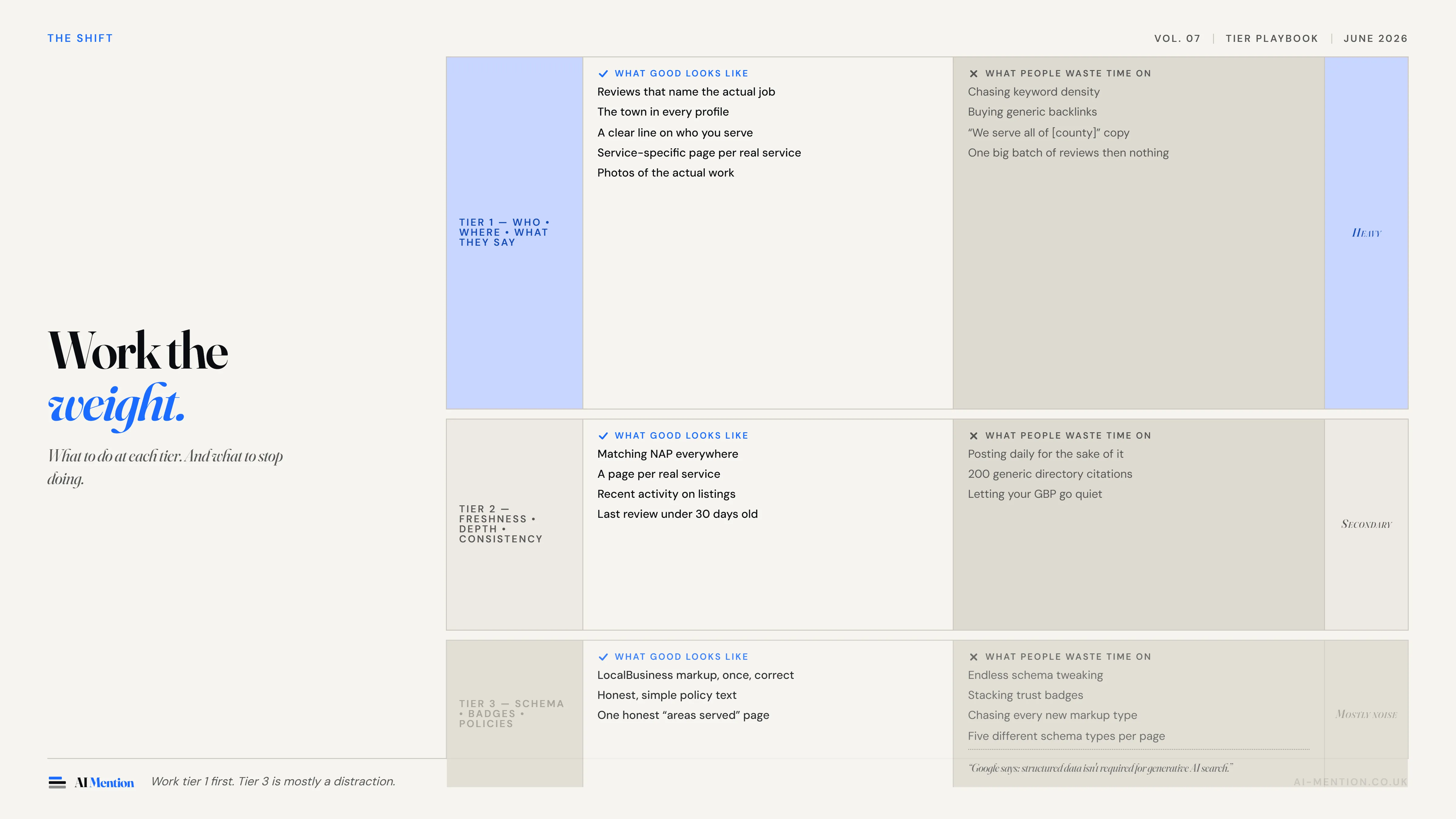
What good looks like in tier 1: a steady drip of recent reviews mentioning the actual job and the actual town, a Google Business Profile that names your service and your area accurately, a page on your website for every specific service you offer.
What people waste time on in tier 1: one big batch of reviews, generic "we serve everywhere" copy, lumping ten different services into a single page.
Tier 2 - Freshness, depth, and consistency
The middle tier is where most local SEO advice lives, and most of it is correct, but it is not the foundation. Once tier 1 is strong, tier 2 starts mattering: how recently your site and listings have been updated, how much there is to read about you that goes beyond the basics, and how consistent your name, address and phone number are across every place AI might check.
A business whose website has not changed in three years tells AI it might not be open any more. A directory listing with last year's phone number sends AI to the wrong place. A blog with six posts on the actual work you do gives AI six more pieces of evidence than a blog with none.
What good looks like in tier 2: regular updates to your Google Business Profile and your website, content that goes into depth on the actual work, name-address-phone identical across every directory.
What people waste time on in tier 2: paying for a citation-blast service that adds the business to 200 generic directories nobody uses. Forty directories that match your industry beats 200 that do not.
Tier 3 - Talked about more than it matters
The third tier is where most of the AI search advice on the internet is pointed, and it is where the lowest amount of actual weight sits when AI explains its picks. Schema markup is the loudest example.
Google itself is plain about it, from the official AI optimization guide: "Structured data isn't required for generative AI search, and there's no special schema.org markup you need to add." Our pattern of observation lines up. Schema rarely surfaces when AI explains why it recommended a business.
This does not mean schema is useless. Google's Local Business structured data documentation is worth following because schema still helps with rich results in normal Google search, and rich results are part of what some AI summaries pull from. But it is not the silver bullet much of the SEO industry sells it as. If tier 1 is weak, no amount of schema will save you.
The same applies to a handful of other signals routinely held up as important: detailed pricing pages, operational policies, "trust badges". They are nice to have. They are not what gets you named.
What good looks like in tier 3: a single LocalBusiness schema block on your homepage, consistent with everything else, and then move on. Time spent here that should have been spent on tier 1 is time wasted.
Frequency
"How do I get recommended more often" is a different question to "how do I get recommended at all". The shape of the answer is the same: strength in tier 1, support in tier 2, basic hygiene in tier 3. The lever for frequency is signal density, the strength of each signal multiplied by how many places AI sees that signal repeated.
A business with a complete Google Business Profile and not much else gets named occasionally. A business with a complete Google Business Profile, recent reviews that name the job and the town, per-service website pages, accurate directories everywhere AI checks, and the basic schema in place gets named often. Not because anyone weighted it up. Because every time an AI looks for something to confirm its pick, the same business keeps being the most consistent answer.
The IAB UK's Futurescape report on AI and brand discovery describes the shift: AI is becoming the layer where customers find brands, and UK businesses are now adapting their content strategies in response. Their AI usage statistics put 56% of UK AI users now using AI daily. The frequency question is no longer hypothetical.
The British Chambers of Commerce's Turning Point report puts UK small business AI adoption past half. The customers using AI to find a plumber, a vet, an electrician, are the same SMEs the BCC tracks. They expect to be found the way they themselves are finding everyone else.
How to start
If you are not sure where the gaps are, the free AI discoverability check on AI Mention measures the signals on your business and tells you which tier needs work. It does not run live AI tests. It scores readiness. That readiness gap is what stops AI naming you in the first place. Run it once, fix the gaps that come back, and you have already done more than most local businesses ever will.
If you want to see how often AI actually names you across the live model lineup, and how often it names a competitor instead, that is what the paid audit reports: the per-platform breakdown of where you are being named, where the competitor is, and which tier the gap sits in.
The "how to get recommended" question is finally being asked in the UK at scale. The businesses that act on the answer first will be the ones AI mentions for the next year. The advice is not secret. The discipline is in working tier 1 first, then tier 2, and not getting distracted by tier 3.
How findable is your business to AI?
Run a free check on your business name and town. Discoverability score, the specific gaps AI looks at, no account needed.
Check my AI discoverabilitySources
Ofcom: From apps to AI search, how the UK goes online in 2025
Ofcom: User experiences of Generative AI Search
IAB UK: Futurescape, AI revolutionises brand discovery
Trustpilot: The power of online reviews in UK growth
Google Search Central: AI Optimization Guide
Google Search Central: Local Business structured data
British Chambers of Commerce: Turning Point as more SMEs unlock AI