AI Doesn't Rank Local Businesses. It Recommends Them. (And That's Why We Changed Our Name.)
A few weeks ago we launched as AI Rank. From this week, we are AI Mention.
The reason is the same reason we exist in the first place: the word "rank" describes the old world, and most local businesses are still being told their AI problem in old-world language. So before we asked anyone else to use the right words, we changed ours.
This post explains what we found, why it forced the change, and what it means if you are a small business trying to work out where you actually stand in AI search.
The word "rank" only works if there is a list
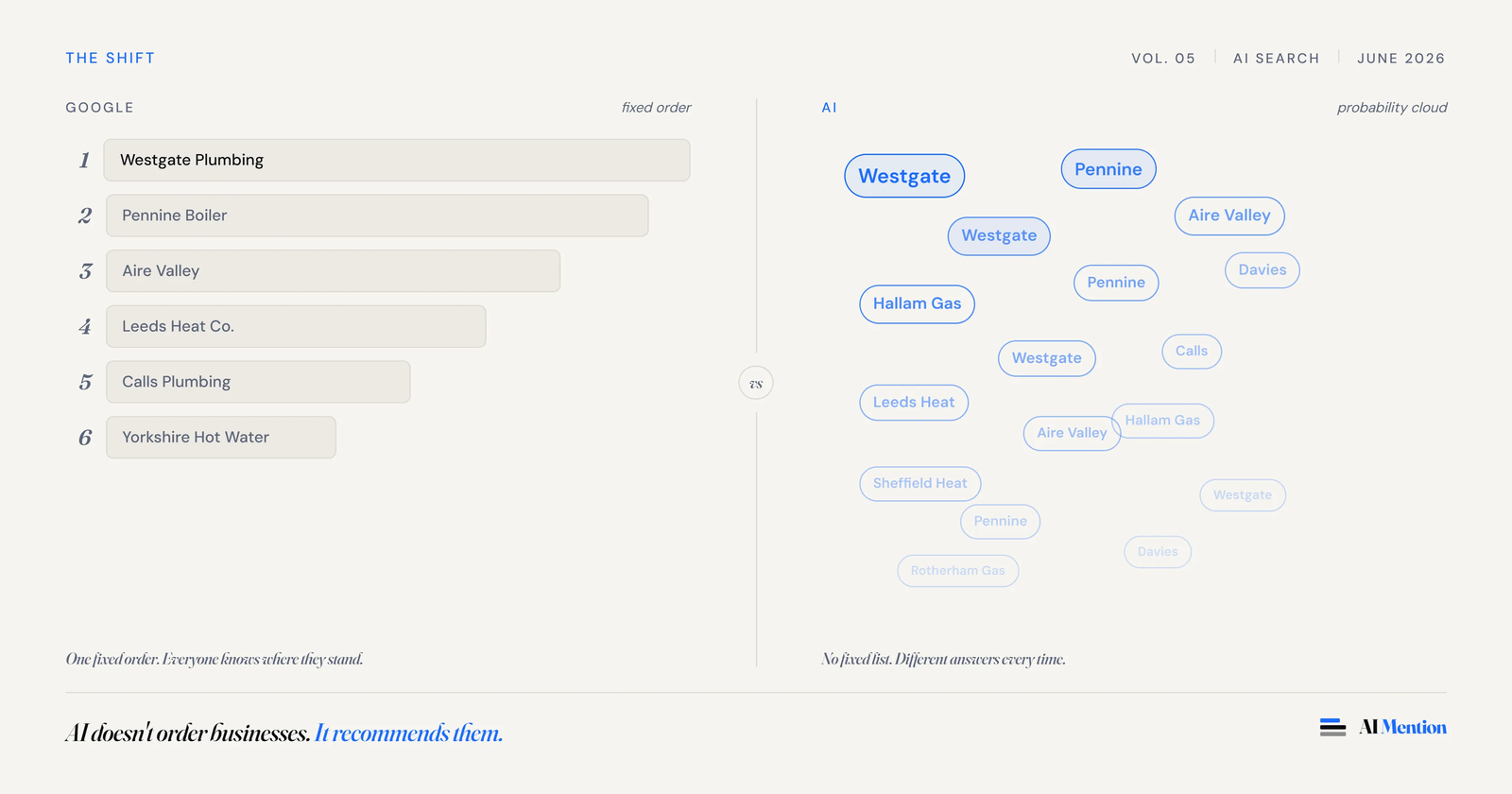
Rank is a position. Position three. Position seven. Position twenty-two. The whole idea only makes sense if there is a list, and the list stays still long enough for the position to mean something.
That was the deal Google offered, and an entire industry was built on top of it. Tools to check your position. Reports to show your position climbing. Agencies paid to move your position up by one or two. All of it leaned on the same quiet assumption: that the list exists, that it is stable, and that your job is to climb it.
AI search broke that deal. It did not just change the list. It stopped making a list at all.
What we found when we looked
We have spent the last few months running thousands of recommendation checks through ChatGPT, Claude, Gemini, Perplexity, Grok, and DeepSeek - asking the kinds of questions a real customer would ask. "Best plumber in Sheffield." "Italian restaurant in Manchester for date night." "Solicitor in Birmingham for a commercial lease."
What we kept seeing was nothing like a ranking.
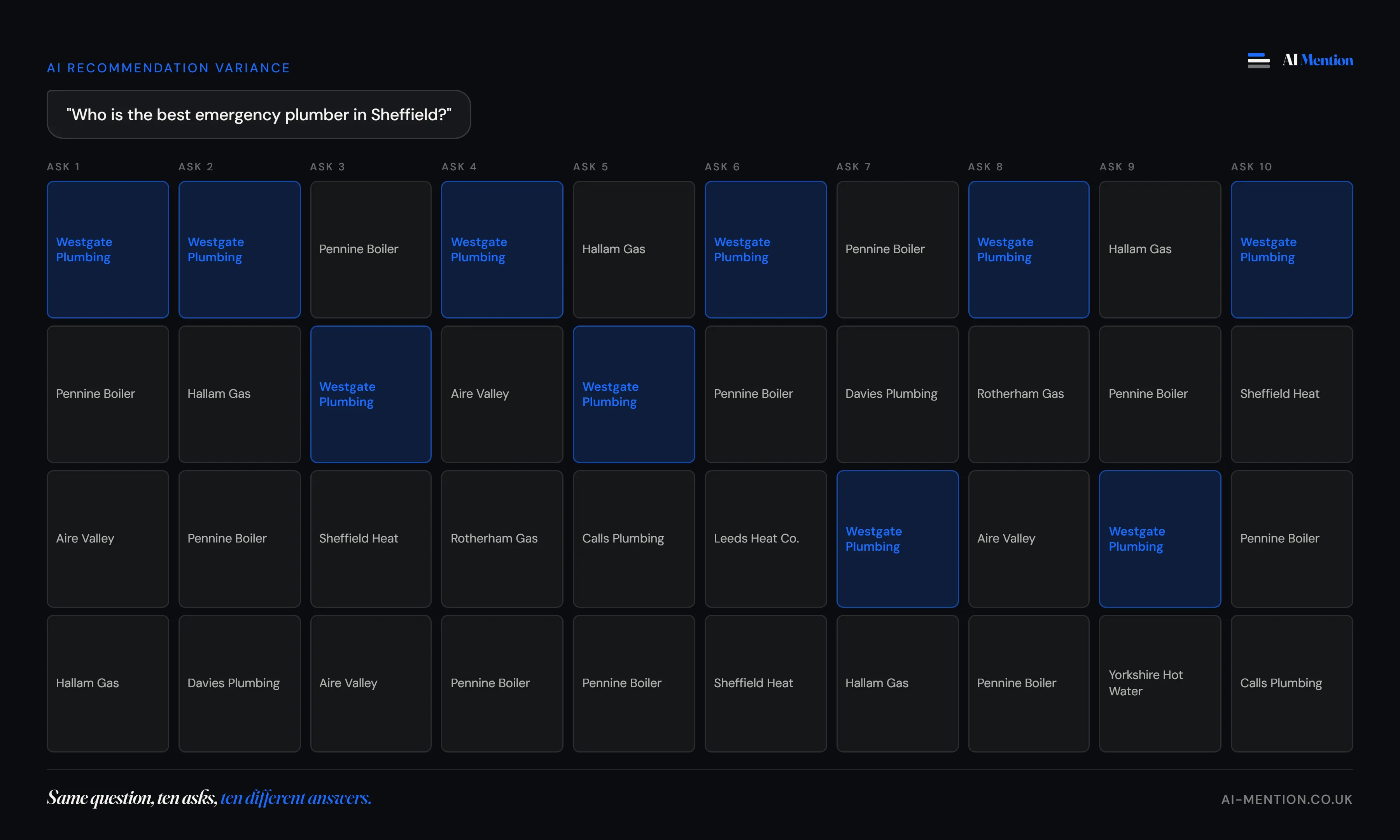
In our testing through May 2026, 64% of the businesses that got recommended only appeared once across the entire test run. They were named, vouched for, then never mentioned again. Ask the same model the same question ten minutes later, and a completely different business would be recommended in their place.
Even on the most consistent model we tested, only around 31.6% of recommendations repeated across runs of the same prompt. Across different models the overlap collapsed further: between any two models, the pool of businesses they would both recommend for the same question was as low as 1.3% to 6.8%.
That is not a ranking. That is a probability cloud, and we kept seeing the same shape no matter which industry, which town, or which question we tested.
You cannot rank what does not stay still
If you cannot reliably reproduce the list, you cannot rank inside it.
Ranking, as a concept, depends on a fixed order. Position three only matters if there is a position three that everyone can agree on. The whole SEO toolkit - rank trackers, position dashboards, share-of-voice charts - works because Google gives you a stable shelf to stand on.
AI does not give you a shelf. It gives you a moment.
A customer asks ChatGPT, "who should I call for an emergency plumber in Leeds tonight?" and the model has to make a decision right there. It pulls together what it has learned about plumbers in Leeds from across the internet - websites, reviews, directory listings, mentions in local press, professional body memberships - and recommends one, two, maybe three businesses by name. Next person asks the same question two minutes later, and the answer might be different.
Your business is not at "position four for plumber Leeds." Your business is either named in that moment, or it is not. That is a fundamentally different problem. And calling it ranking, while comforting, gets it wrong in a way that misleads people into doing the wrong work.
What "mention" actually measures
When we shifted the language to mentions, the work got clearer almost overnight.
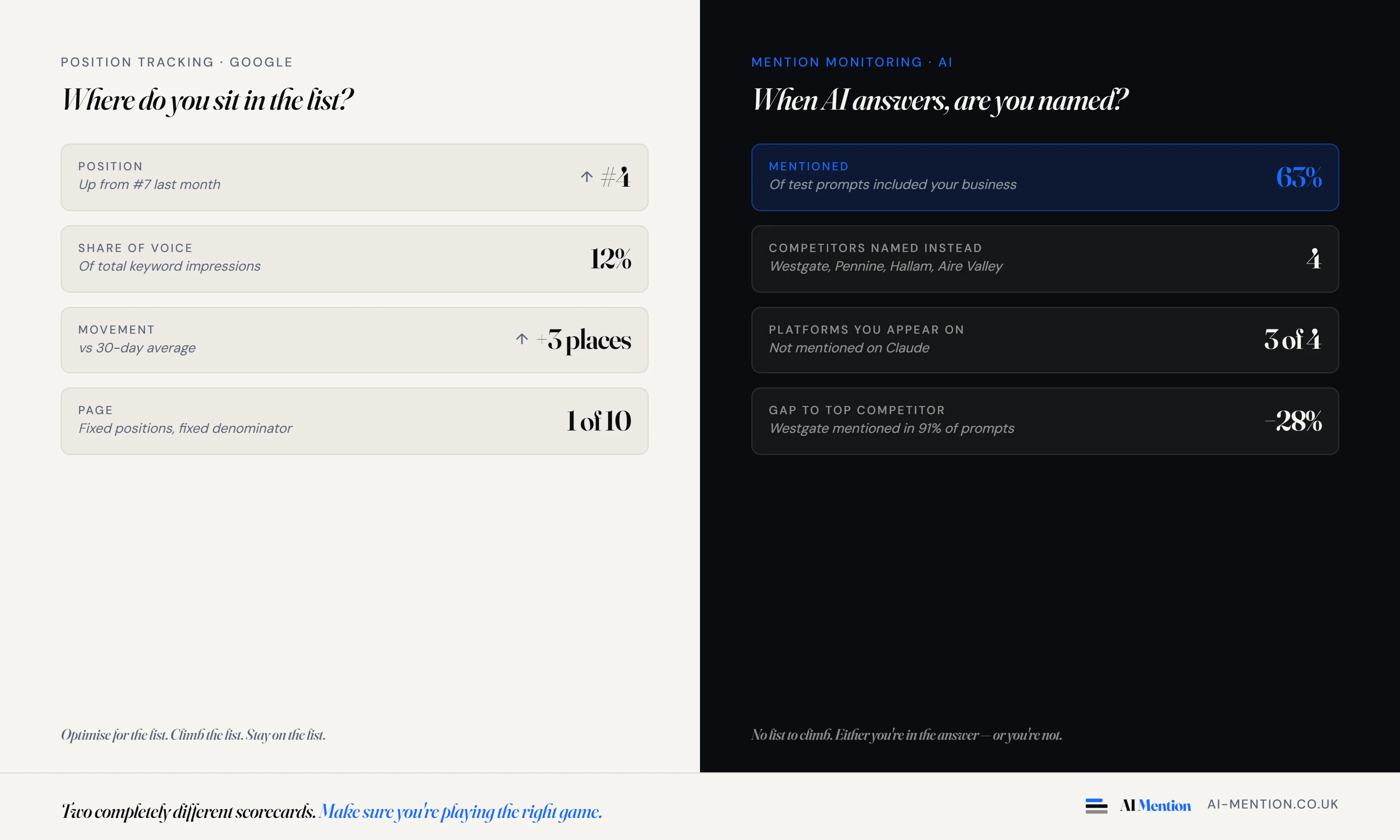
A mention is something you can count without pretending it is stable. Across a hundred runs of a realistic customer question in your area, how many times did the AI name you? Out of all the businesses it could have picked, how often did it pick yours? Which models mention you more often than others? Which competitors are getting named in the moments where you are not?
Those are answerable questions. They are honest about how the system works. And they map directly onto the only thing that matters commercially: are AI customers being sent your way, or someone else's?
"Rank checking" implies there is a leaderboard to climb. "Mention monitoring" describes what is actually happening - a steady, partly random stream of recommendation moments, where your job is to be the kind of business the AI is confident enough to name out loud.
Why this matters for your business
If you treat AI as a ranking problem, you will look for a position, find that there is not one, and either give up or chase the wrong tactics. Plenty of "AI SEO" advice still leans on language and habits borrowed from Google rank tracking, and most of it does not survive contact with how the models actually behave.
If you treat AI as a mention problem, the questions get useful immediately:
- How often does AI mention you when a customer asks about your service in your area?
- Which competitors keep getting named when you do not?
- What is consistent across the businesses that AI keeps mentioning, and what is missing from yours?
- Which models give you the most mentions, and which barely know you exist?
That is what we built AI Mention to answer. Not a position. A picture of how often AI is choosing you, and why it is choosing other people when it is not.
The name fits the work
There is one more reason the change felt overdue. When we tell a plumber in Leeds that their "AI rank" has dropped, they imagine a Google-style leaderboard with their name sliding from third place to seventh. That picture is wrong, and the wrong picture leads to wrong fixes.
When we tell them their "AI mentions" have dropped, the picture is right. Customers are still asking. The AI is still answering. Your name is just no longer the one coming out of its mouth as often. That is a real, fixable problem - and it starts with seeing the gap honestly.
So we changed our name. Same product, same team, same calibration data underneath. Different word on the door, because that is the word that actually describes what we measure.

Why some of our older posts still say AI Rank
A practical note, because you might notice this.
If you click into the older articles on our blog, you will still see the name "AI Rank" on some of the artwork, in some of the screenshots, and woven through the writing. The data in those posts is still right. The findings are still right. The advice is still right. Only the name on the door has changed.
We thought about going back and rewriting all of it. We decided not to. Rewriting history is a lot of churn for very little reader benefit, and it would mean retouching artwork that was carefully made for the original pieces. Instead we are phasing the new name in gradually, post by post, from this one forward. New articles will be written as AI Mention from the start. Older articles will stay as they were written, with the original name they were published under.
If you are joining us through this article, everything we publish from here on will use the new name. If you are an existing reader, nothing about what we measure or how we measure it has changed. The work that produced the original calibration findings is the same work that is producing the new ones. The name just finally matches the verb.
See your own mentions
If you have never checked how findable your business is to AI, the cheapest thing you can do this week is find out.
Our free check looks at the readiness signals AI models use to decide whether to recommend you in the first place - your website, your schema, your reviews, your directory presence, all the things AI cross-references when it picks a business. You get your discoverability score and the specific gaps in 30 seconds. No account needed. Just your business name and your town. From there, a paid audit shows you exactly how often AI is actually naming you across the live lineup, and how often it is naming a competitor instead.
The leaderboard you were trying to climb does not exist. The mentions you can actually win do.
Check if AI mentions your business
Run a free check to see how often AI mentions your business, who it names instead, and what to improve first.
Check my AI mentionsSources
AI Mention calibration testing through May 2026 - 64% single-appearance rate, ~31.6% reproducibility on the most stable model, 1.3% to 6.8% cross-model overlap.
Google, May 2026 AI Optimization Fundamentals - confirms there is no separate technical "AI SEO" layer to game; the underlying work is on findability and consistency, not position.