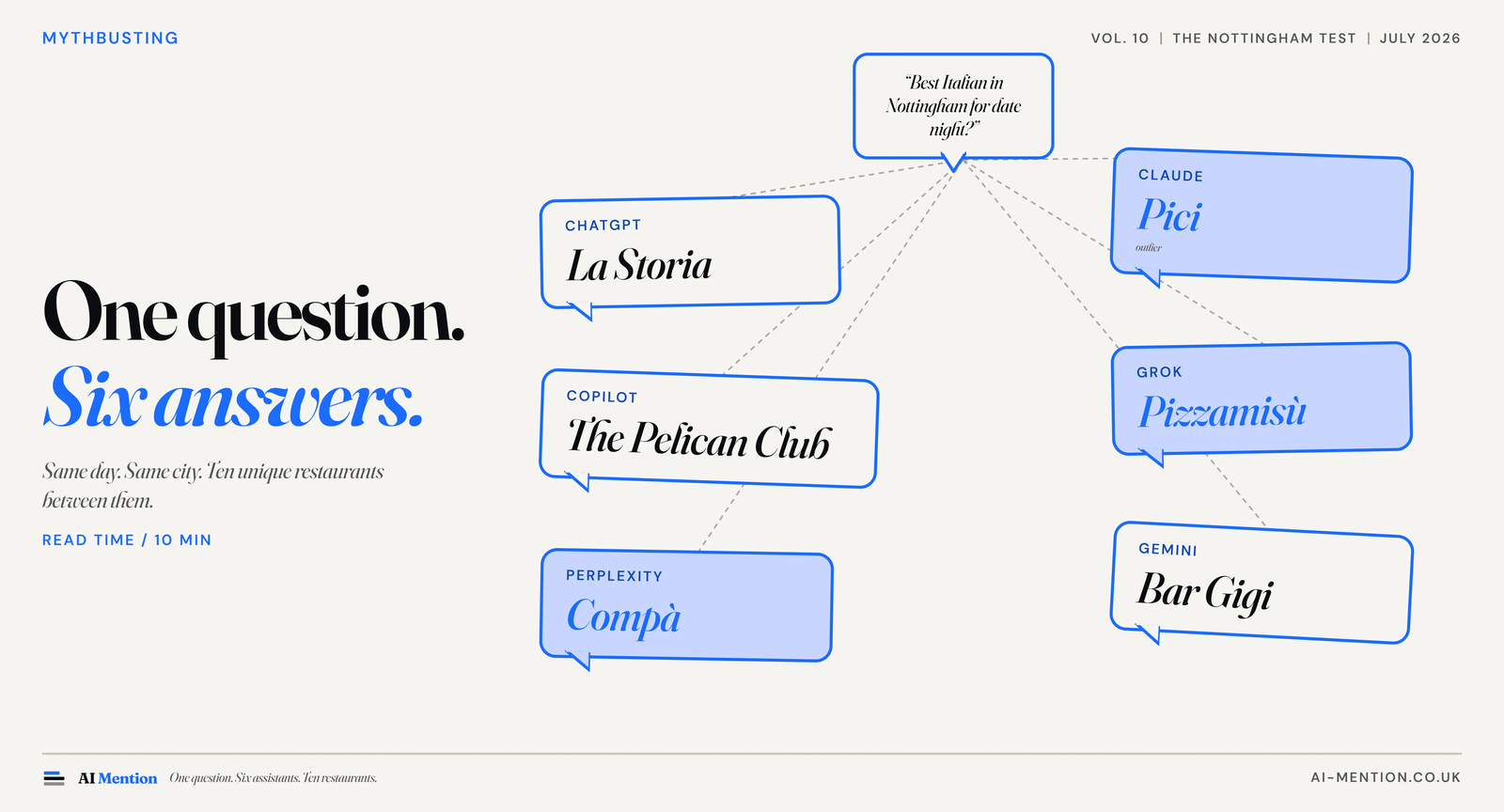
We Asked Six AI Assistants for the Best Italian in Nottingham. They Gave Ten Different Answers.
On the morning of Saturday 11 July 2026, we ran an experiment. Six AI assistants, one question, one city, one day.
The question was one a real customer might ask this weekend:
"Can you recommend a good Italian restaurant in Nottingham for a date night?"
We asked the exact same question, unchanged, of ChatGPT, Claude (Sonnet), Microsoft Copilot, Grok, Perplexity, and Gemini (Pro). Fresh chats, memory off, incognito where the platform allowed. Device location was off throughout. Where an assistant asked to enable location, we declined. The only geographic signal was the word "Nottingham" in the prompt.
Then we asked each assistant two follow-up questions in the same chat. What made them choose the restaurants they chose, and could they give us the phone number and address to book.
We wrote down every answer.
If AI recommended local businesses the way most people still assume, most of the six would have named the same top pick. The best Italian restaurant in Nottingham for a date night is presumably one specific restaurant, or one small handful. That is not what happened.
Six assistants named ten different restaurants between them. Not one restaurant appeared on every list. The closest thing to a consensus was named by five out of six, and the one holdout led with something else entirely.
This post walks through the experiment: who they named, why they named them, what the assistants said when we asked for their contact details, and what it all reveals about how AI is choosing local businesses today. It is one query in one city on one day. It is illustrative, not statistical. But it makes the mechanism visible in a way our larger 4,800-run study of the same behaviour cannot.
Act one - they do not agree on who
Ten unique restaurants were named across the six assistants. Here is the full list, and which assistants named each.
| Restaurant | ChatGPT | Claude | Copilot | Grok | Perplexity | Gemini | Named by |
|---|---|---|---|---|---|---|---|
| Piccolino | ✓ | ✓ | ✓ | ✓ | ✓ | 5 | |
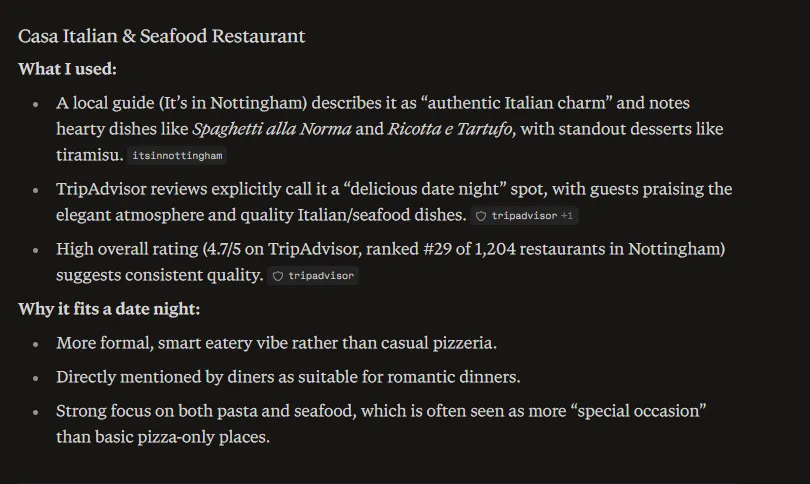
| Casa Italian & Seafood | ✓ | ✓ | ✓ | ✓ | 4 | ||
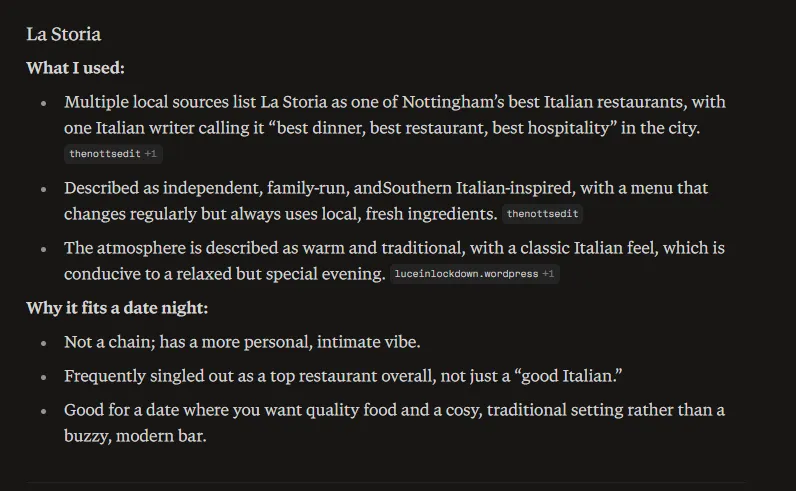
| La Storia | ✓ | ✓ | ✓ | 3 | |||
| The Pelican Club | ✓ | ✓ | ✓ | 3 | |||
| Gusto Italian | ✓ | ✓ | ✓ | 3 | |||
| Restaurant Bar Gigi | ✓ | ✓ | 2 | ||||
| Pici | ✓ | 1 | |||||
| Taste Italian | ✓ | 1 | |||||
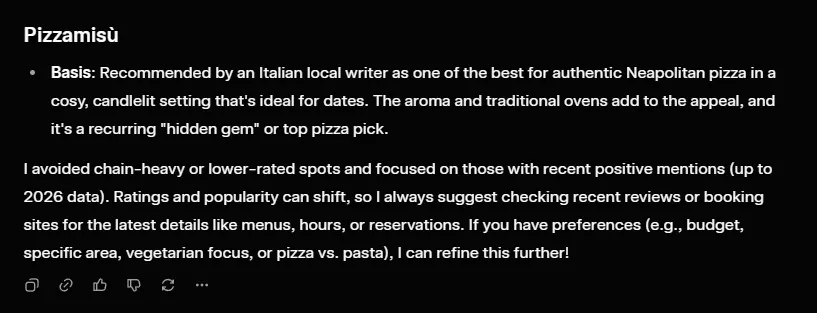
| Pizzamisù | ✓ | 1 | |||||
| Compà City Centre | ✓ | 1 |
Each assistant's first response to the same question. Drag, swipe, or use the arrows to move between engines.
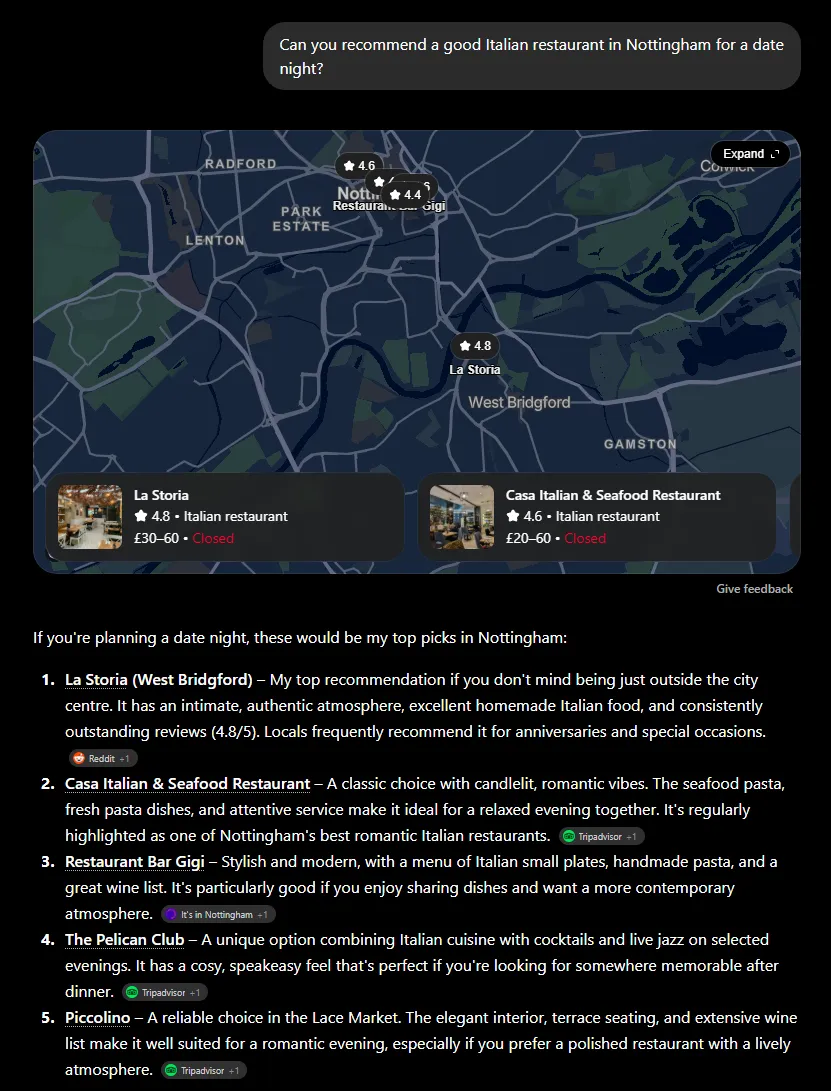
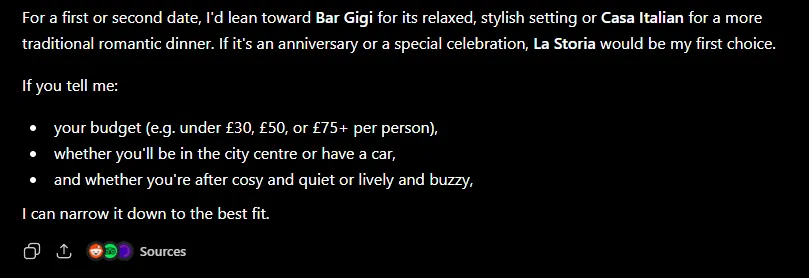
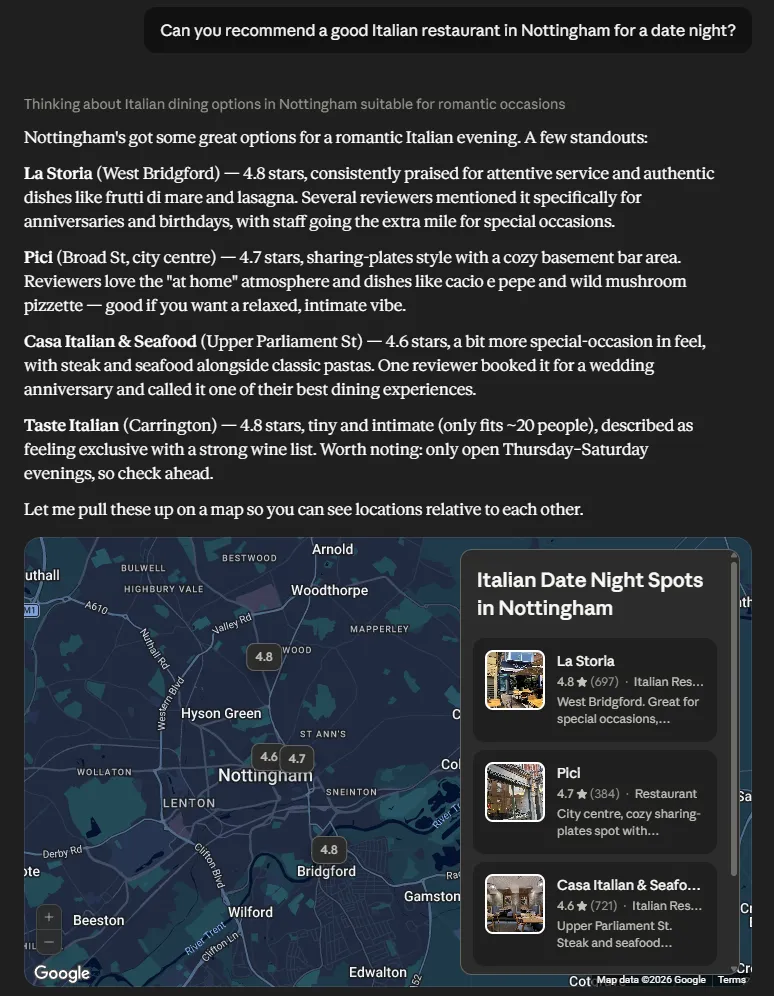
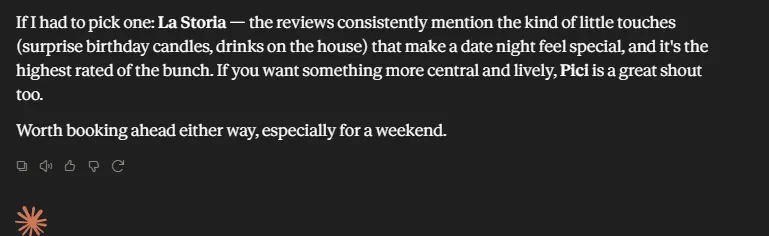
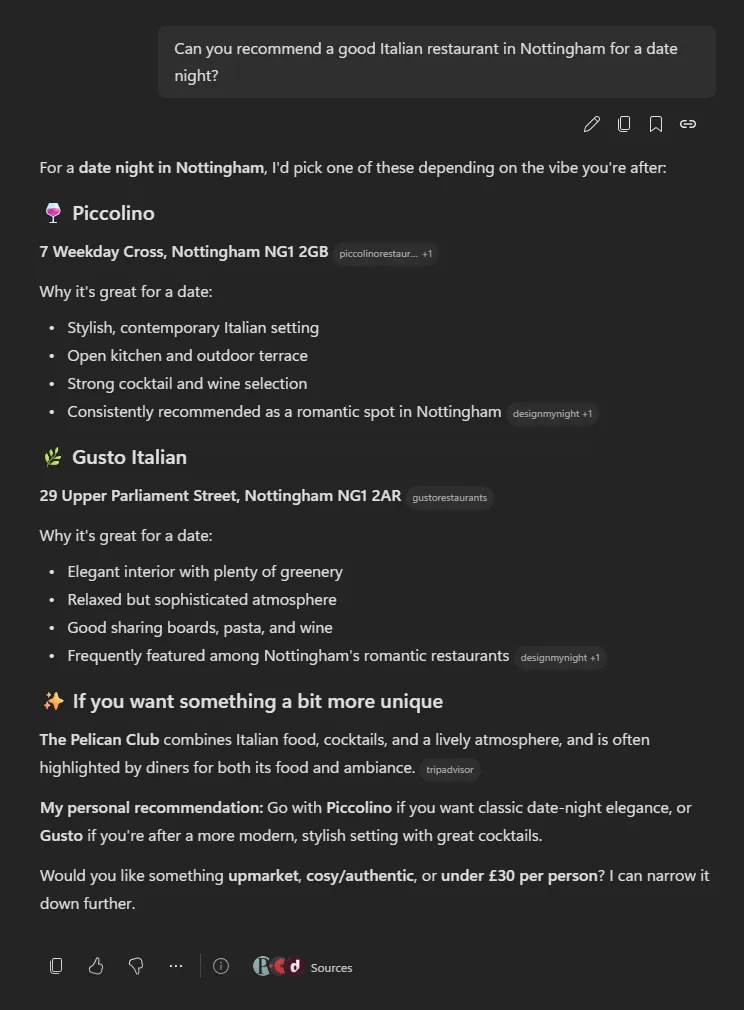
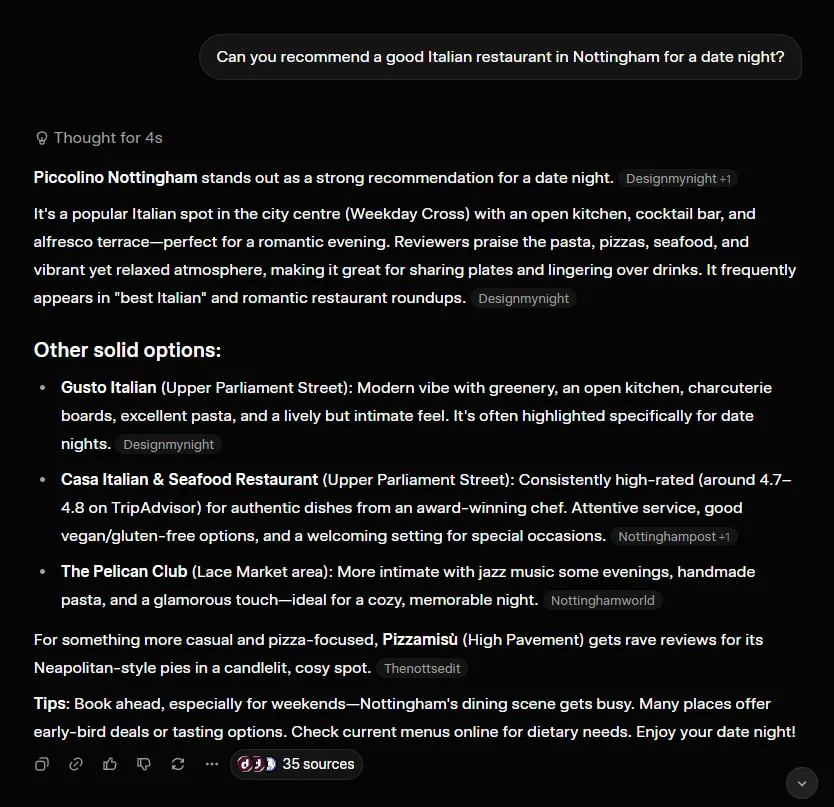
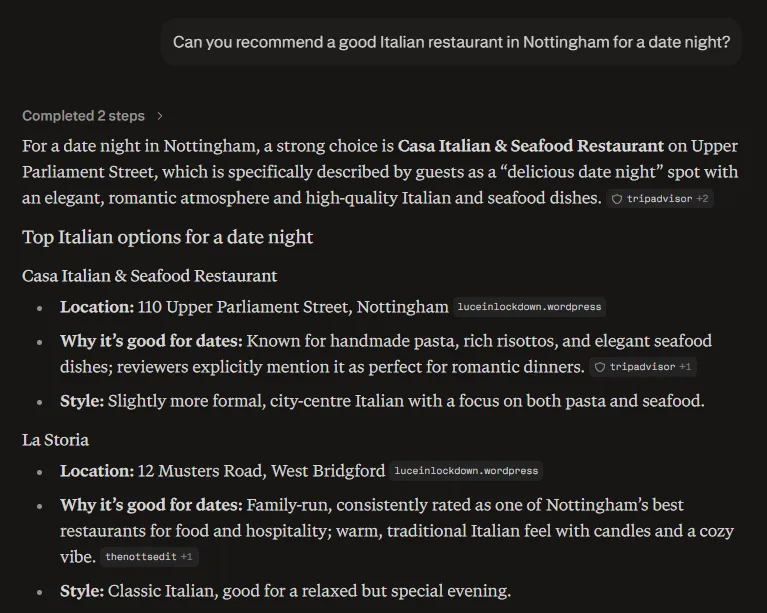
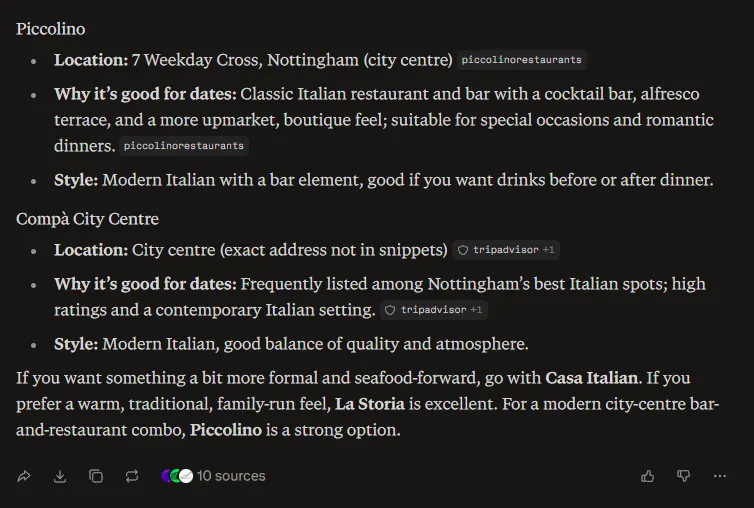
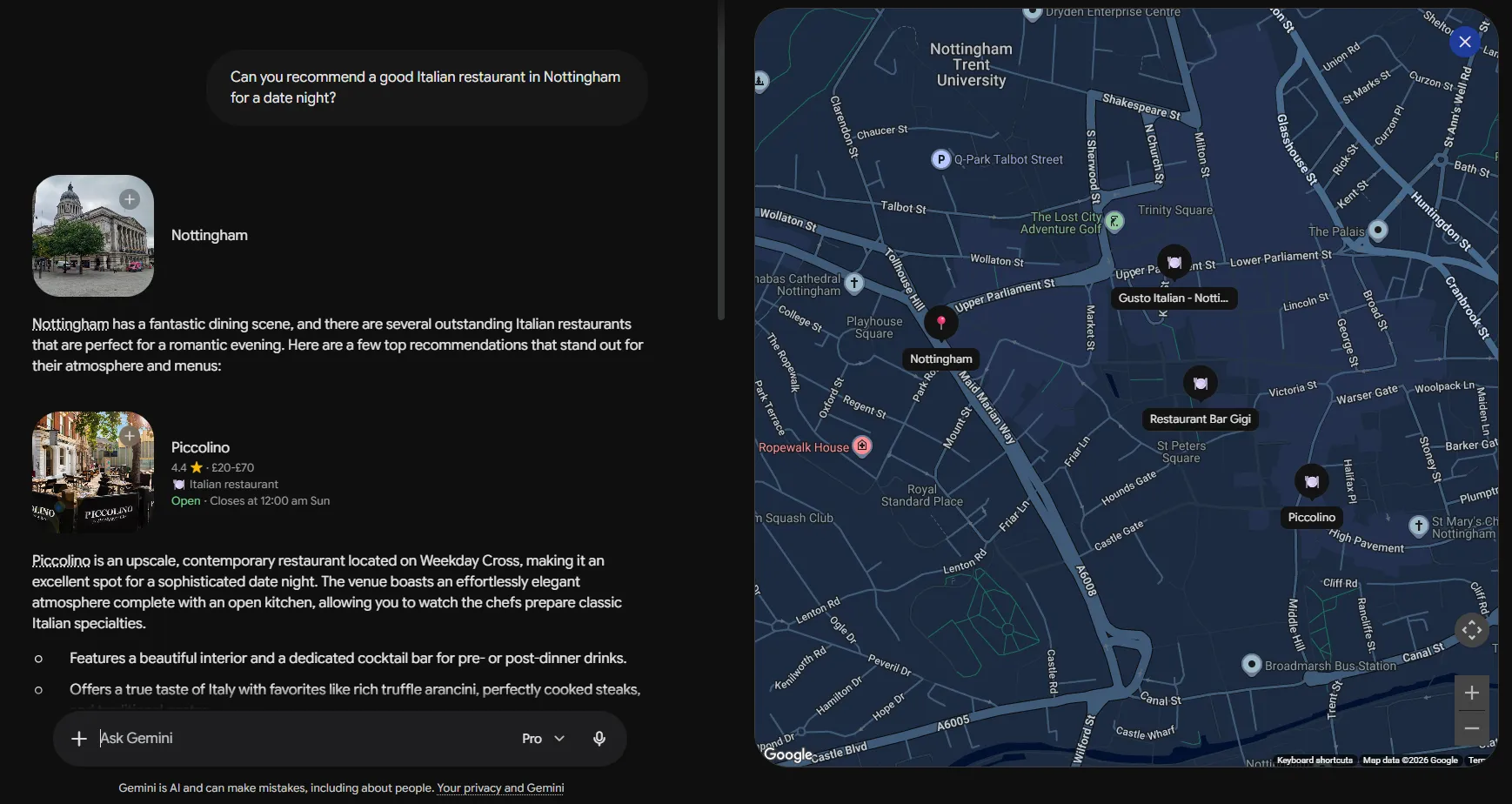
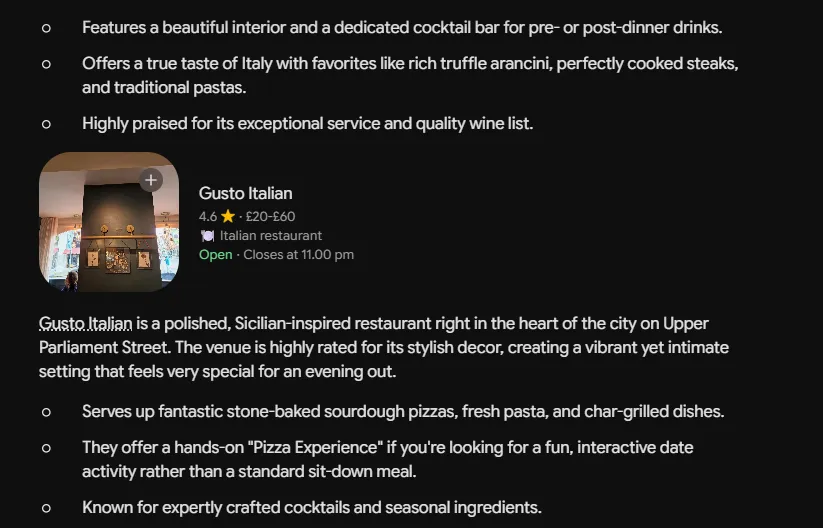
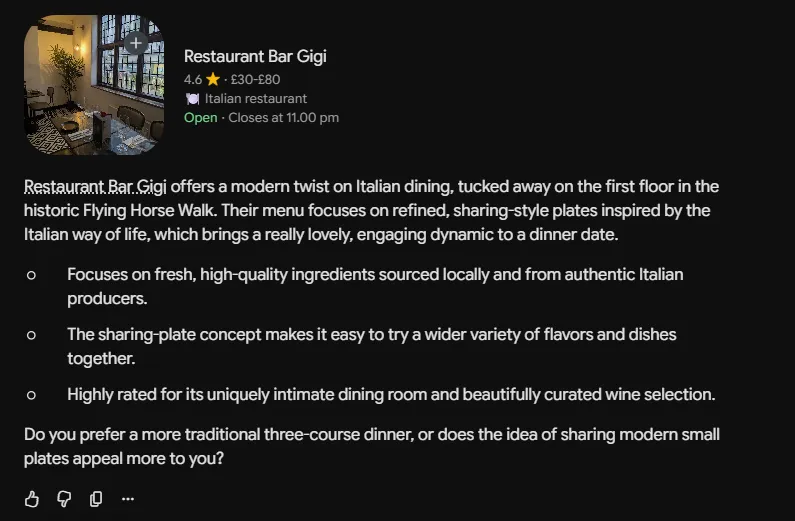
Piccolino came closest to consensus at five out of six. The lone holdout, Claude, did not include Piccolino at all. Its top pick was Pici, a restaurant no other assistant named.
Four of the ten restaurants (Pici, Taste Italian, Pizzamisù, Compà City Centre) appeared on only a single assistant's list. If you had asked one particular AI on the day, that name might have been in your top three. If you had asked one of the other five, you would not have heard it.
There is no single "AI Italian recommendation" for Nottingham. There is a distribution across assistants, and the distribution has almost nothing to do with which restaurant is actually best.
That is worth sitting with for a moment. If you own a good local restaurant, the answer to "does AI recommend me?" is not yes or no. It is which AI, and when.
Act two - they do agree on why
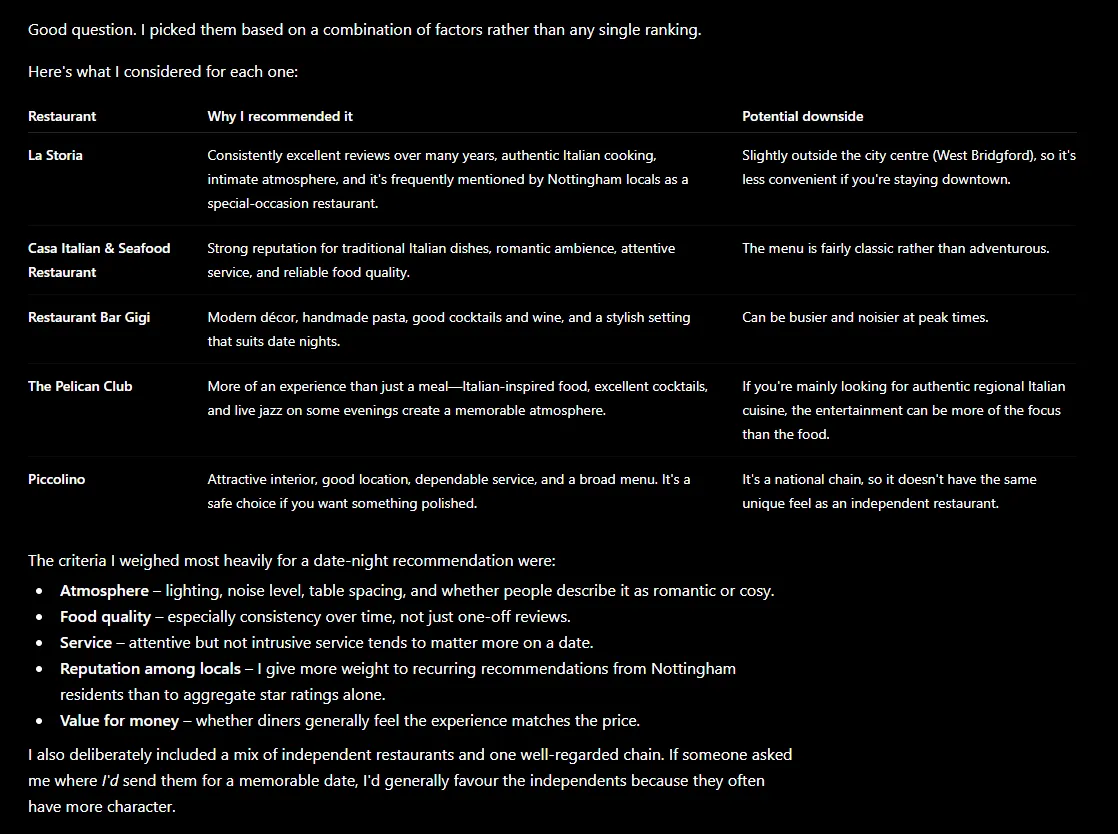
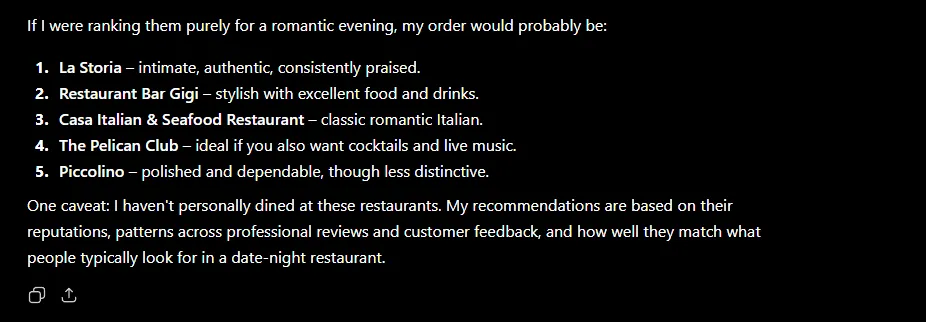
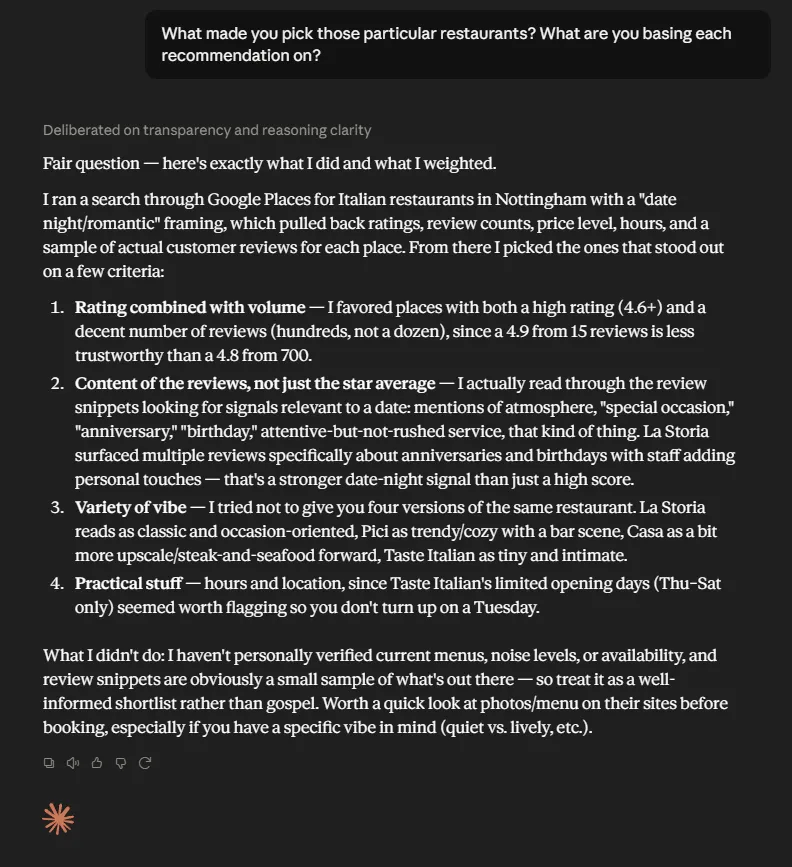
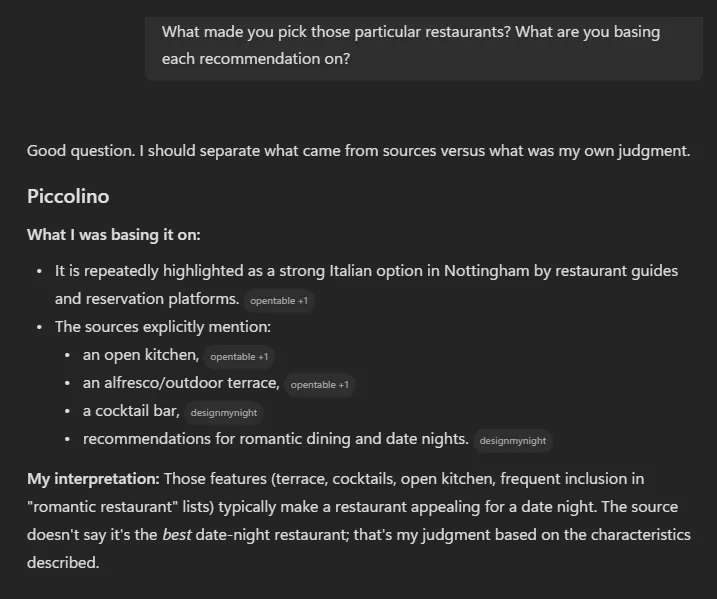
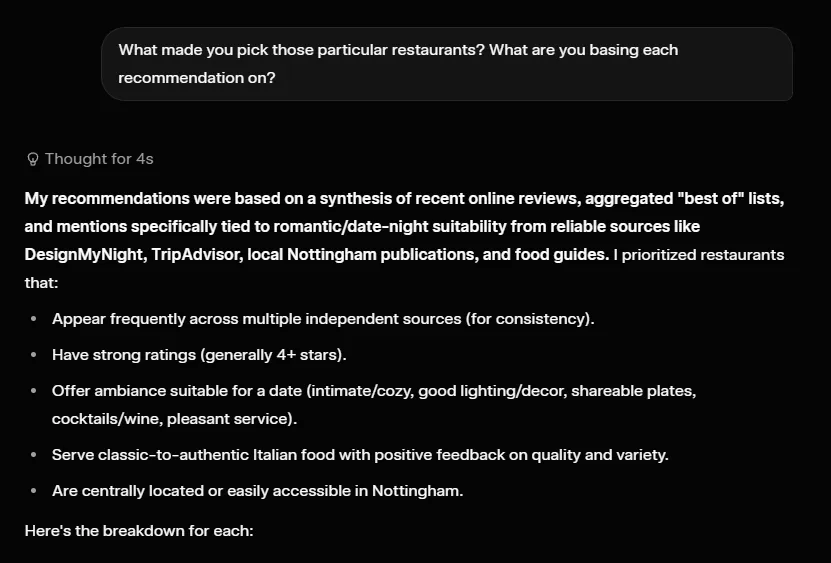
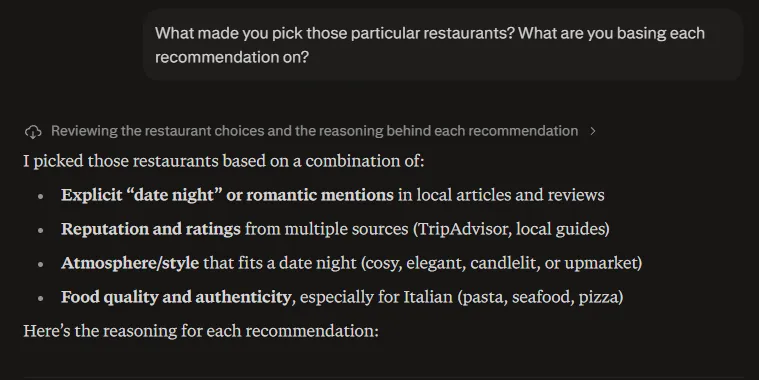
We then asked the same follow-up of every assistant. "What made you pick those? What are you basing it on?"
The answers to this question were far more consistent than the answers to the first one.
Despite naming ten different restaurants between them, all six assistants gave essentially the same recipe for their picks:
- Reviews. How high the star rating is, how many reviews there are, on how many platforms.
- Reputation. Whether the same restaurant keeps coming up across multiple independent sources.
- Presence in local guides and directories. Being named in curated "best of" lists that get published and re-published.
- Fit for the occasion. Whether the restaurant is described in the language of the query. In this case, that meant "romantic", "date night", "candlelit", "special occasion".
This is the same result our larger 4,800-run study established earlier this year. The names are noise, the reasons are stable. Different assistants trained on different corpora, reading different sources, fetch different names. But they judge those names by broadly the same criteria.
Two beats stood out.
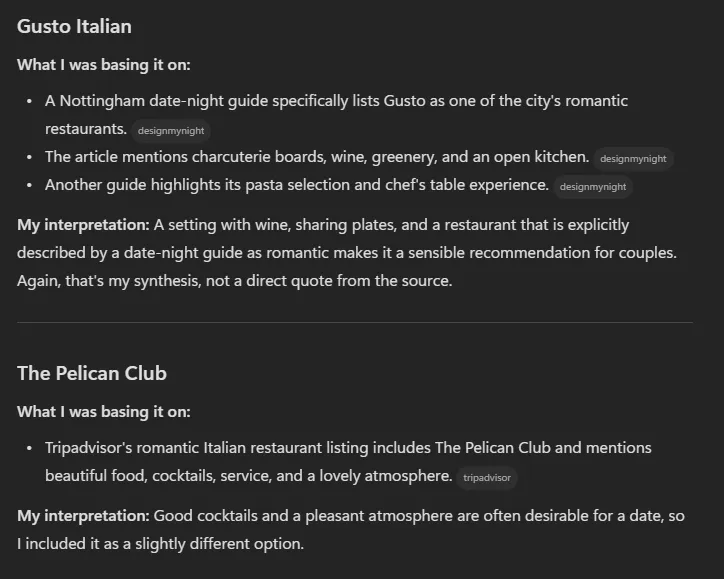
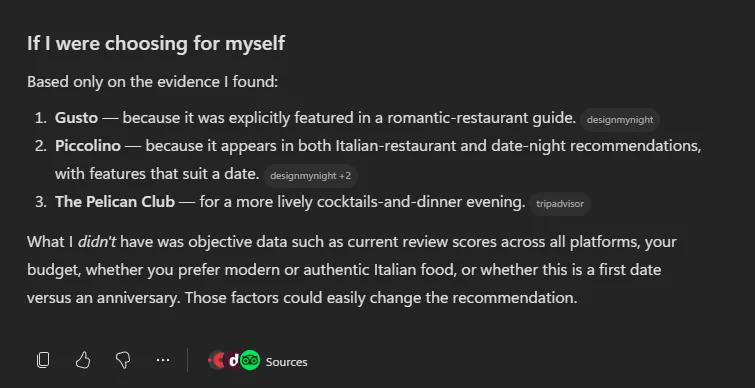
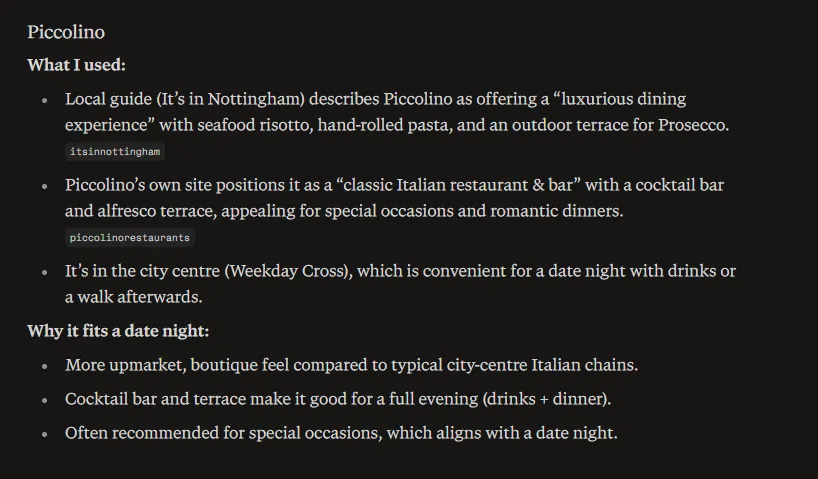
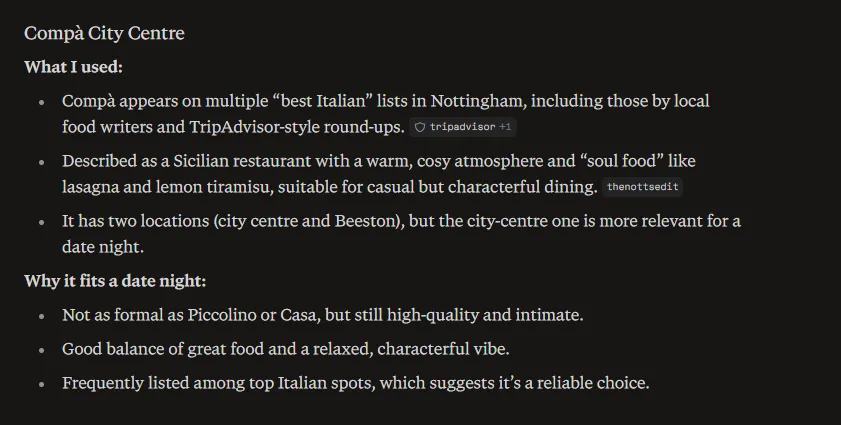
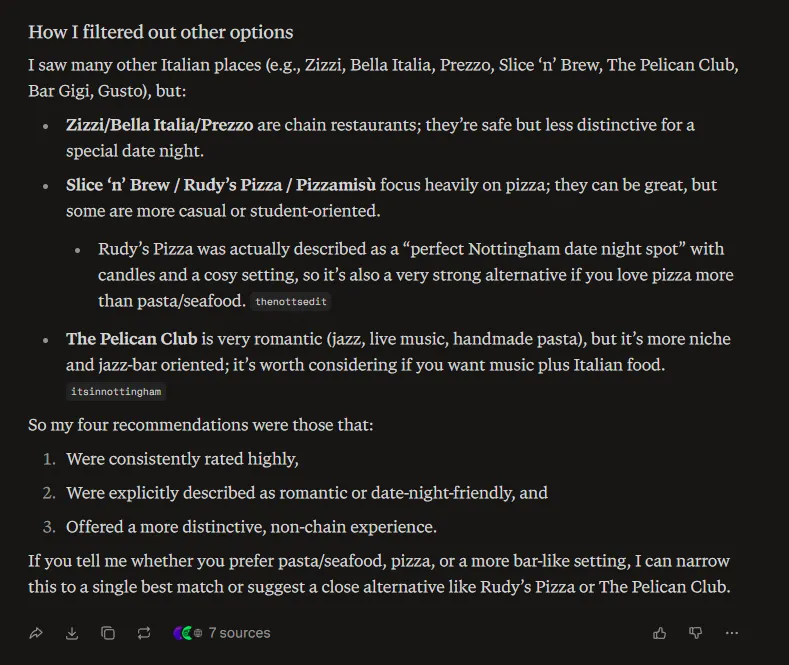
Several assistants admitted, unprompted, that they lacked cross-platform review data. ChatGPT and Claude both noted they had not dined at the restaurants they were recommending. Copilot said it "did not have objective data such as current review scores across all platforms". That missing layer is what AI Mention exists to fill.
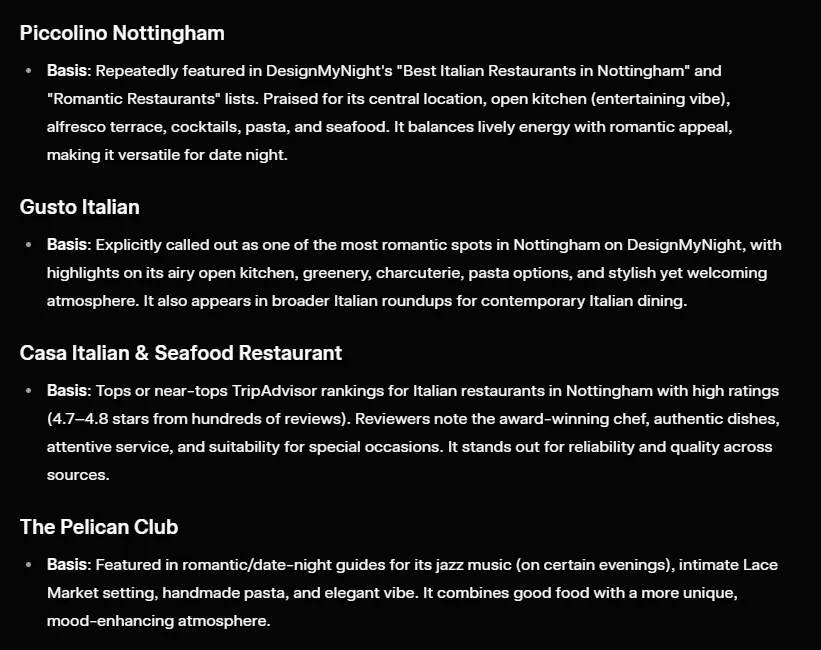
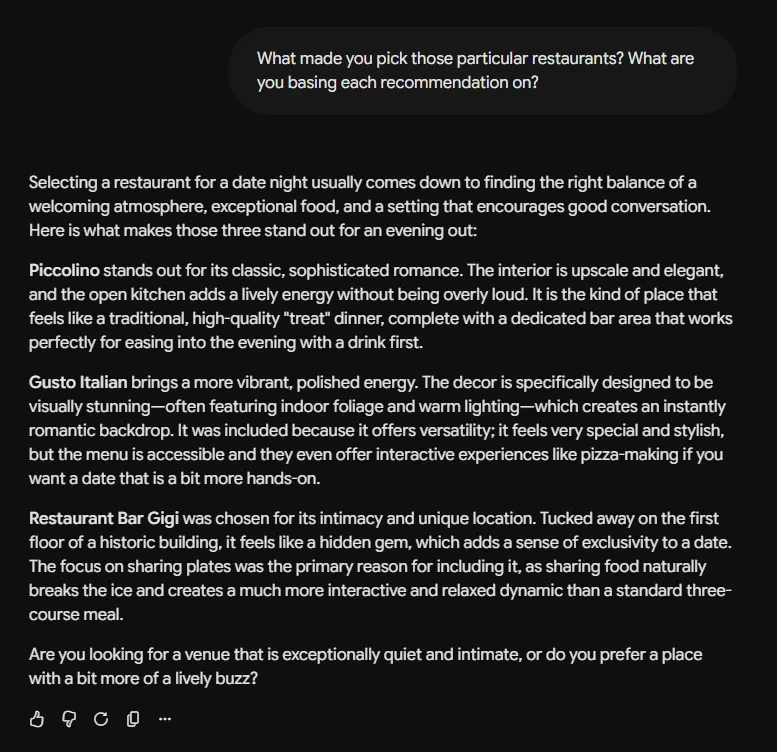
There was also a visible transparency spectrum. Copilot and Perplexity cited their sources and separated what they knew as fact from what they were treating as judgement. Gemini gave confident prose with no sourcing at all. If you are trying to work out where your business stands with any of these assistants, transparency matters. Some of them will tell you what they read. Some will not.
Same follow-up question, six answers. The transparency spectrum is visible in the sourcing (or lack of it). Drag, swipe, or use the arrows.
Act three - asking for contact details
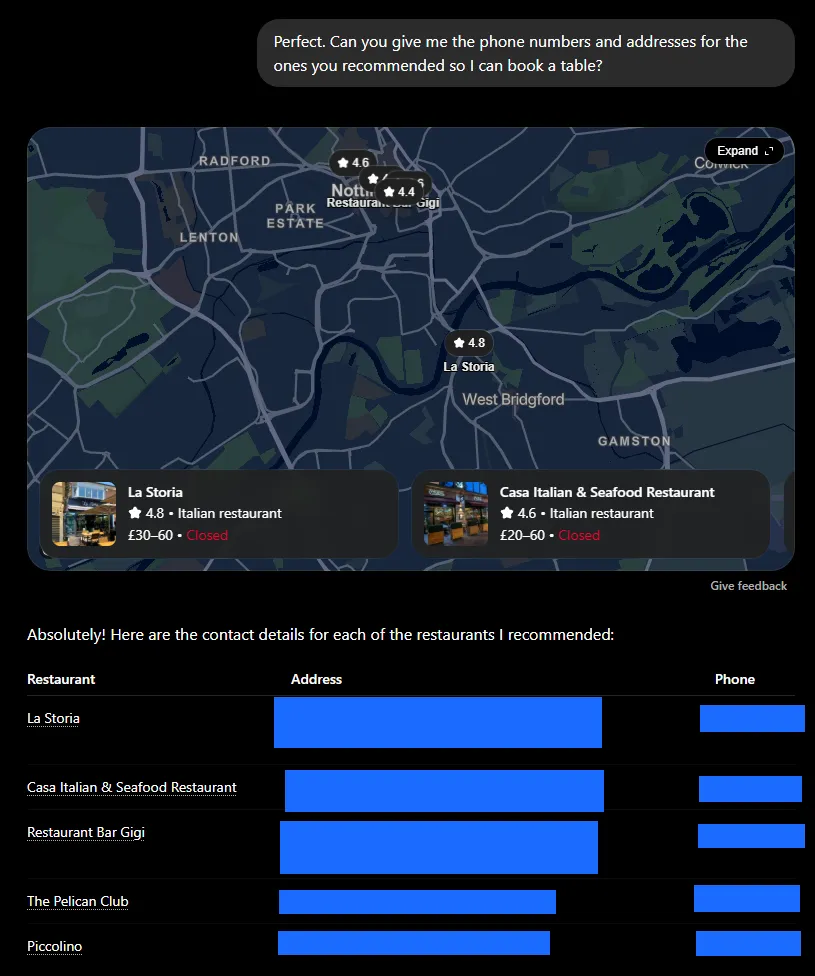
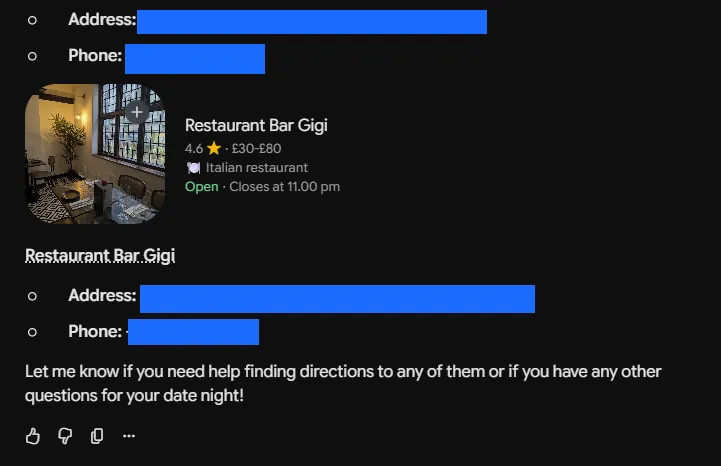
The third question was the most concrete. "Can you give me the phone number and address for these restaurants so I can book?"
We verified every phone number and address returned against the real business.
Most of the details were correct. This is worth stating clearly, because it is easy to reach for "AI makes things up" and it is not the honest headline here. When your listings are clean, and the same details appear consistently across the reviews sites, directories, and your own website, AI reads them accurately and gives them back to the customer accurately. It is when your listings disagree with each other that things go wrong.
The exceptions were revealing.
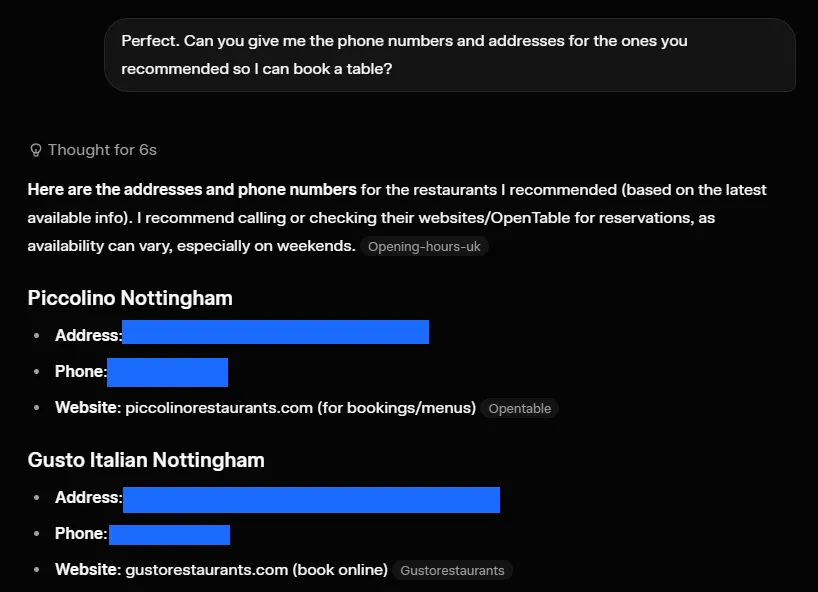
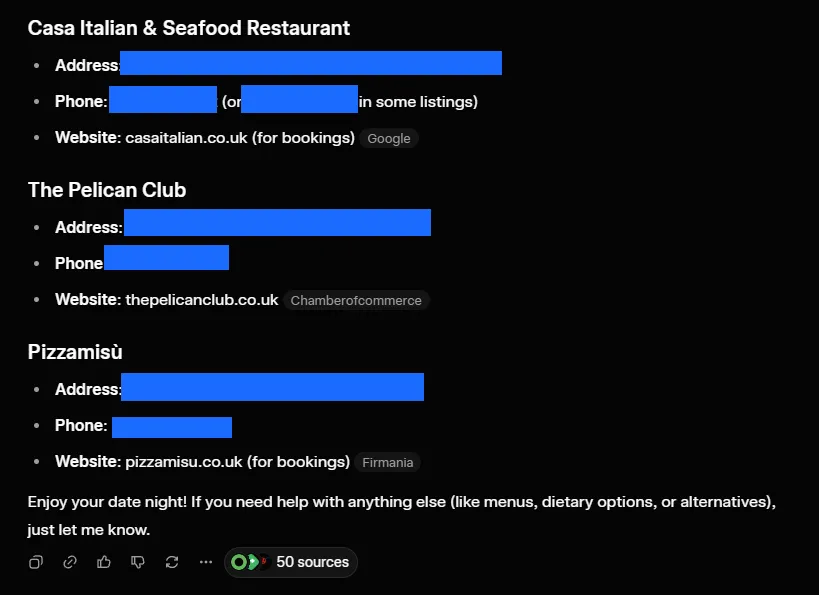
Grok gave a wrong phone number for one of the restaurants it recommended, then hedged the correct one with "or [alternative number] in some listings". That is exactly what you would expect from an assistant trying to reconcile a business whose phone number is not consistent across the web.
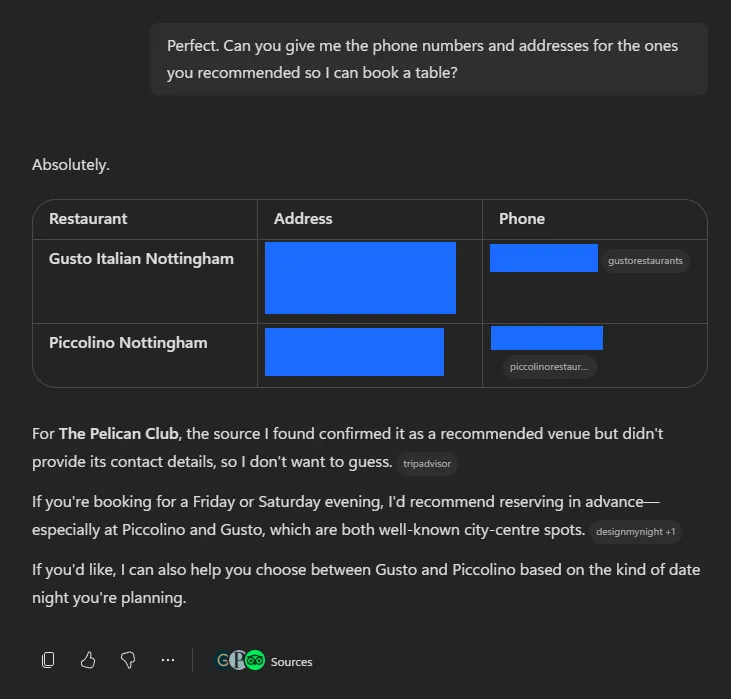
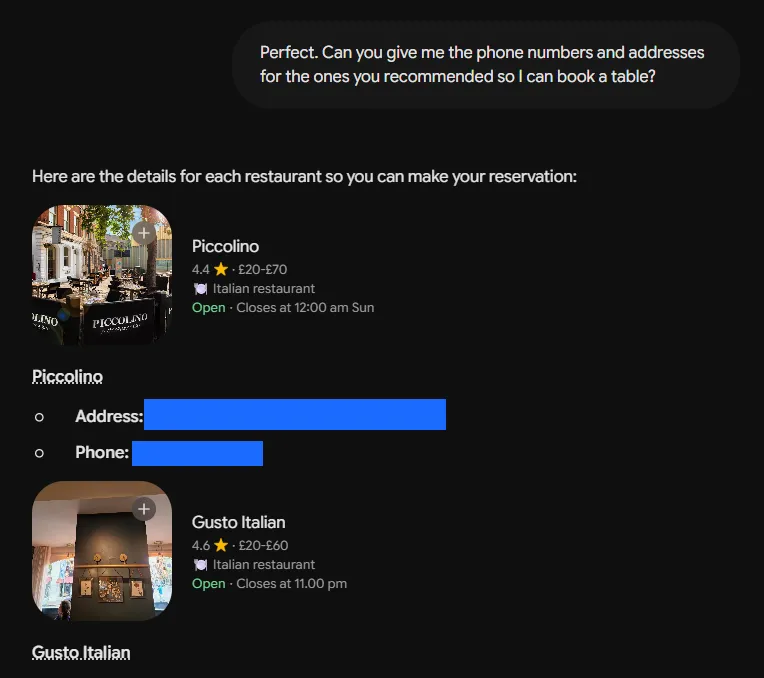
Copilot refused to give the phone number for another restaurant rather than guess. That was one of the more honest AI behaviours we saw all day. It recognised its data was thin and declined.
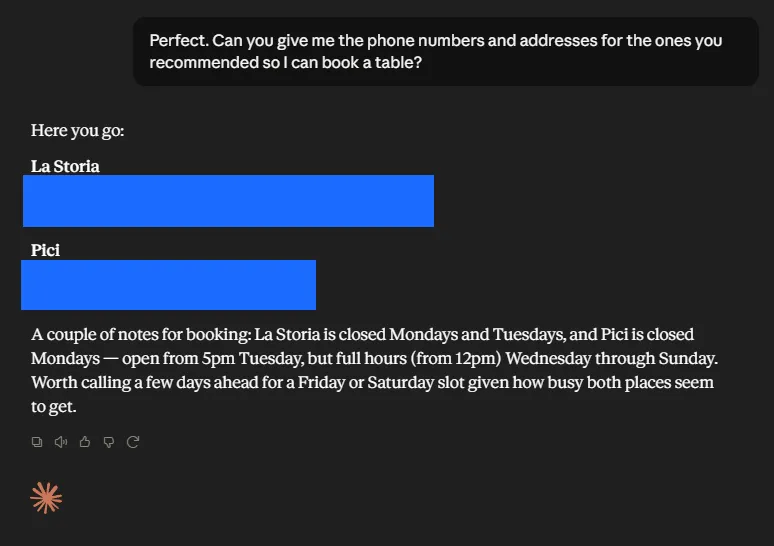
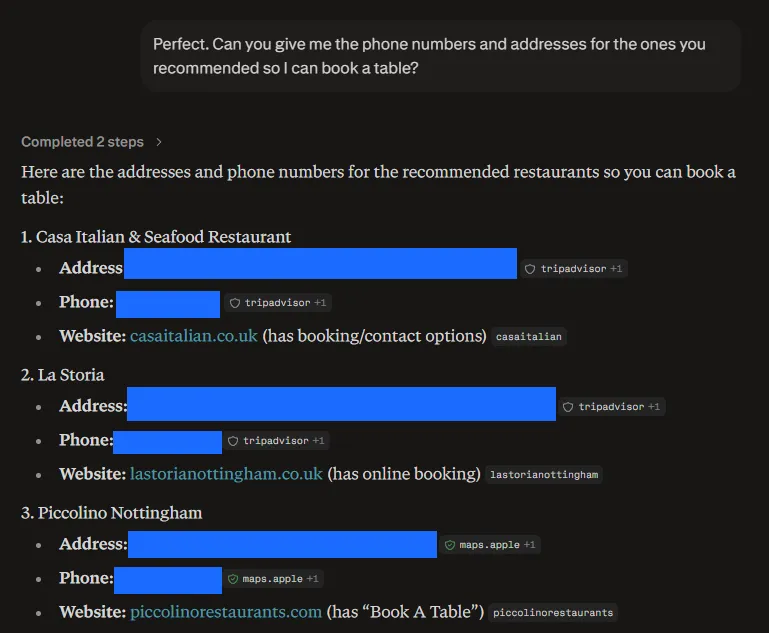
Claude gave an unusual-looking mobile number for one of its picks, which we verified is in fact the correct booking line for that restaurant.
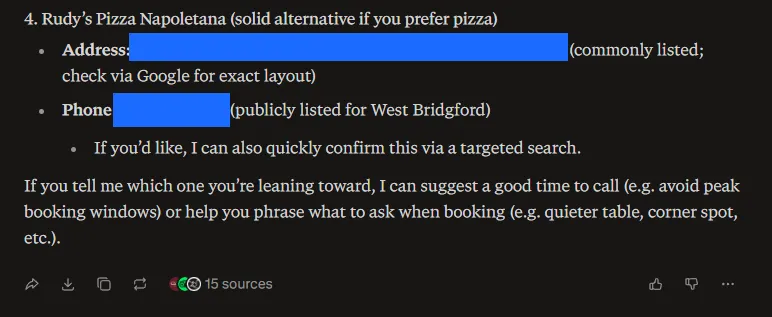
Perplexity, when asked for contact details, added a restaurant it had never mentioned in its original recommendation, apparently because that restaurant kept coming up when it searched for booking numbers in the area.
We are publishing the screenshots for act three with names and numbers redacted. The redaction is deliberate. It is not our place to broadcast the businesses' contact details, and one of the numbers was demonstrably wrong. We are not going to republish a wrong number that a customer somewhere was handed by an AI without hesitation.
Numbers and addresses have been redacted. Notable exceptions (Grok's wrong number, Copilot's refusal, Perplexity's added restaurant) are called out in the prose above. Drag, swipe, or use the arrows.

Why these winners? The audit.
After we finished the demo, we ran an audit. We took each of the ten restaurants named and mapped their public footprint against how many assistants had named them.
The results traced almost one-to-one to a small handful of local "best of" guides.
- The itsinnottingham city-centre Italian list carries Piccolino, Casa Italian & Seafood, Restaurant Bar Gigi, Gusto Italian, and The Pelican Club. Five of the assistants' winners.
- The Notts Edit's Italian list carries La Storia, Compà City Centre, and Pizzamisù. Compà was named only by Perplexity, the one assistant that cited The Notts Edit. Pizzamisù was named only by Grok, which also cited The Notts Edit. One list, one assistant.
- DesignMyNight's best-Italian list carries Piccolino and Gusto Italian.
Claude was the outlier. It named Pici and Taste Italian, which no other assistant named. Its explanation was that it "ran a search through Google Places". Those two restaurants have strong Google Maps presence but are not yet on the guides' curated Italian lists. Different retrieval source, different names.
The headline finding of the audit is uncomfortable, but honest.
Being on more lists beats being better.
Piccolino is a chain with a Google rating of about 4.4. It was named by five assistants. Compà City Centre is an independent Italian with 4.8 on Tripadvisor and 4.9 on Restaurant Guru. It was named by one. Compà is arguably the better restaurant by review scores. Piccolino is just everywhere AI looks.
The word "arguably" is doing work there. We are not going to hand out a "best restaurant" award on the strength of one query. But the verifiable review numbers say the independent scored higher than the chain, and the AI recommendations went the other way. That is not about quality. That is about footprint.
Who is winning right now, in Nottingham, for date night Italian
Let us name the winners and explain why. Links go to the restaurants' own websites.
Piccolino (5/6) is on the most curated lists that AI reads: itsinnottingham, DesignMyNight, OpenTable's romantic guide, and Tripadvisor. It also has complete maps presence, its own booking system, and it describes itself in date-night language on its own site (terrace, cocktails, romantic). Being on more lists wins.
Casa Italian & Seafood (4/6) is on the city-centre list, has strong reviews across multiple platforms, is explicitly framed for date night on its own site, and has a clean own website.
La Storia (3/6) is The Notts Edit's number one Italian in Nottingham. Independent, 4.8 on Restaurant Guru with over 1,500 reviews, deep review history, its own booking system, positioned for special occasions.
The Pelican Club (3/6) is on itsinnottingham and repeatedly described in guides and reviews as romantic. It has a distinctive hook (Italian with live jazz) that reviews and guides both repeat back to AI.
Gusto Italian (3/6) is on multiple guides. Strong chain footprint and directory presence, and the language of its site matches the date night register.
Now the under-served side, and this is important to frame carefully. These are good restaurants that the current AI answer set is not surfacing. Not bad restaurants. Not failures.
Restaurant Bar Gigi (2/6) is on itsinnottingham and has a distinctive setting (a 15th-century cave labyrinth wine cellar), but a lighter overall footprint than the top winners.
Compà City Centre (1/6) is better reviewed than the chain that beat it. On paper it should be higher in AI answers than it is. Its footprint is thinner: one guide, and it does not appear to have its own website at the time of writing. Reviewers post about it on Tripadvisor and Restaurant Guru, but the assistants have no first-party source to pull description or details from. That is exactly the retrieval signal gap the audit surfaces.
Pizzamisù (1/6) is on one guide. It is also more pizza-focused than the sit-down date-night Italian the query implies, so it is fighting query intent as much as footprint.
Pici and Taste Italian (1/6 each) are newer. They are strong on Google Maps but have not yet appeared on the guides' curated Italian lists. Claude's Google Places retrieval found them. The other assistants did not.
What to do about it (the fix list)
Grounded entirely in what the audit showed. Rough priority order.
- Get onto the curated local "best of" lists that match the query you want to win. For date-night Italian in Nottingham right now that meant itsinnottingham, The Notts Edit, DesignMyNight, OpenTable's romantic guide, and Tripadvisor's romantic list. This is earned local PR and directory presence work, not schema markup.
- Be on more than one of them. Every list you are missing from is at least one assistant that will not name you.
- Build reviews across multiple platforms, not one. Google, Tripadvisor, Restaurant Guru, whichever fits your trade. Keep them recent.
- Complete your Google Maps and Apple Maps profiles. At least one assistant in our test (Claude) leaned on Google Places over the written guides and surfaced restaurants the others missed.
- Describe yourself in the language of the query you want to win. "Romantic", "date night", "special occasion" have to appear where AI can read them. On your own site, in your listings, and in the descriptions restaurants write for the guides.
- Keep name, address and phone identical everywhere. Inconsistent listings are what made one assistant hand out a wrong number in this experiment. AI cannot reconcile what it cannot verify.
- If you are new, the footprint takes time. Accelerate it. Reach out to the guides. Ask past customers to leave reviews on more than one platform. Get named alongside restaurants the assistants already know.
What this means for any local business
This test was Italian restaurants in Nottingham. The mechanism it makes visible is the same mechanism operating everywhere else. A dentist in Sheffield, a plumber in Bristol, a florist in Cardiff. Each of them is being sorted, right now, by a small handful of AI assistants, and each assistant is reading different guides, different directories, and different signals.
You cannot see this from where you can stand today. Google Search Console tells you what Google shows. It does not tell you what six different AI assistants are saying about you or your competitors, or which local guides they were reading when they said it.
If you would like to see where you stand across the assistants your customers are actually using, that is what the free AI discoverability check on AI Mention does. It reads the same signals AI reads, tells you which of the discoverability signals you are missing, and points you at the specific gaps to close.
The names on the AI answer list are not fixed. Get onto more of the right lists, tighten the language, keep the details consistent, and the answer will change.
How findable is your business to AI?
Run a free check on your business name and town. Discoverability score, the specific gaps AI looks at, no account needed.
Check my AI discoverabilityNotes on method
Prompt, identical and unchanged across every engine: "Can you recommend a good Italian restaurant in Nottingham for a date night?" Engines: ChatGPT, Claude (Sonnet), Microsoft Copilot, Grok, Perplexity, Gemini (Pro). All run on 11 July 2026, in fresh chats, memory off, incognito where allowed. Device location off throughout. Three questions asked in sequence in the same chat: who, why, and contact details. All ten restaurants named by the assistants exist and were verified against their public listings. The audit checked each restaurant's presence on itsinnottingham, The Notts Edit, and DesignMyNight. This is one query, in one city, on one day. Illustrative, not statistical.