How To Get Your Business Mentioned On ChatGPT
"How do I get my business on ChatGPT" is now a real question UK owners are asking. But it hides three different jobs, and people who lump them together end up working on the wrong one.
Being mentioned on ChatGPT is not the same as being recommended, and neither is the same as being cited. This post pulls the three apart, then shows what actually makes a small business mentionable, and how to check whether ChatGPT is naming you right now. It draws on our own dataset of 4,800 AI recommendation tests across ChatGPT, Claude, Gemini and Perplexity, published open under a CC-BY licence on Zenodo.
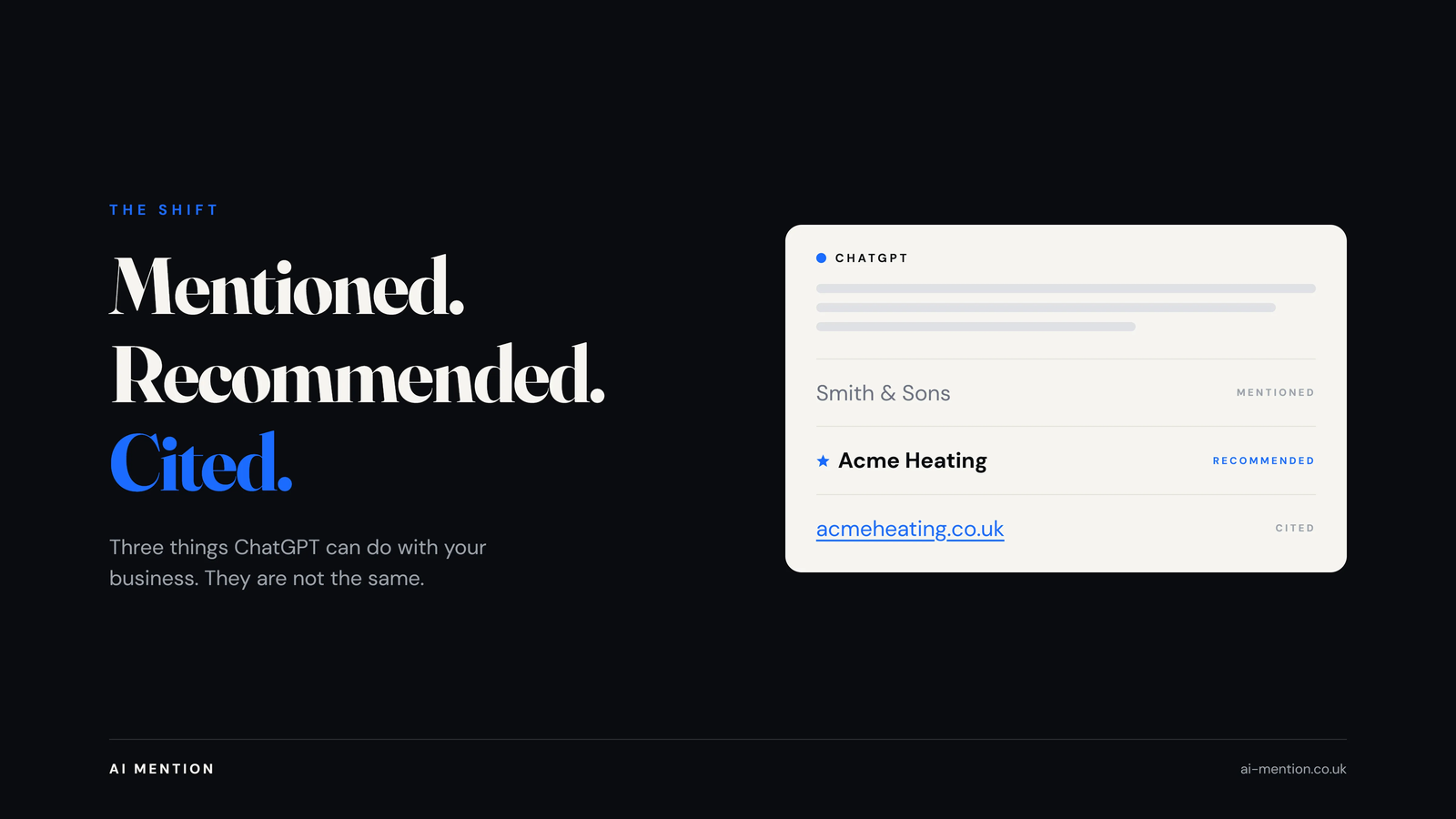
Mentioned, recommended, cited: three different things
Ask ChatGPT "who are the good plumbers in Sheffield" and a reply might read: "A few well-reviewed options include Smith & Sons and Acme Heating. Acme Heating is Gas Safe registered and covers most of the S postcodes." Three things are happening in that sentence, and they are worth separating.
Mentioned means your brand name appears in the answer at all. Smith & Sons got mentioned. It was named, in passing, as one of "a few options".
Recommended means ChatGPT points the buyer at you specifically. Acme Heating was recommended. It got the extra sentence, the reason, the nudge.
Cited is different again. It means ChatGPT used your website as a source when it answered a question, and, when search is switched on, links to it. You can be cited on a question that never names you as the business to hire, for example if ChatGPT quotes your guide on "how often should a boiler be serviced" while recommending someone else.
Most of the advice online conflates all three into "show up on AI". They are separate outcomes with separate levers. The good news is that the work compounds: the things that get you mentioned are the same things that, done well enough, get you recommended and cited.
What "being mentioned" actually means on ChatGPT
ChatGPT answers from what it has read. There are two routes to being in that reading. The first is the model's trained memory, the frozen snapshot of the web it learned from. The second is live search: when ChatGPT decides a question needs current information, it fetches pages, reads them, and grounds its answer in what it just retrieved. That second route is the one you can move quickly, because it reads the live web, not a snapshot from months ago.
A mention is your name surviving that process. Whether from memory or from a live fetch, your brand shows up because the text ChatGPT is drawing on has your name sitting next to the thing being asked about. Get cited and you are the source. Get mentioned and you are in the answer. Neither happens because you asked for it. Both happen because the material ChatGPT reads keeps putting your name where the question is.
Why brand mentions matter more than they look
A single mention feels small. It is not, because mentions compound. Every place your name appears next to your town and your service is another piece of evidence ChatGPT can ground an answer in, and another chance to be the name it reaches for next time.
Our dataset shows why this is the whole game. Across those 4,800 tests we logged 19,810 individual business mentions covering 3,583 distinct UK businesses. But 64.1% of those businesses were mentioned only once. One mention is common. Being the business AI keeps returning to is rare, and that gap is exactly where the work sits. You are not trying to get named once. You are trying to be the consistent answer, the brand whose name turns up no matter which way the question is phrased.
What ChatGPT treats as a mentionable brand
When we classified the reasons AI gave for its picks across eight platform and category cells, some signals showed up almost every time and some were far more hit and miss.
- Local relevance appeared in 79% to 100% of reasoning across the cells.
- Authority and credibility ran from 84% to 100%.
- Service specificity, how precisely you match the exact thing asked, ran from 70% to 99%.
- Reviews and reputation were more variable, 36% to 77%.
- Directory presence swung wildest of all, 16% to 99%, depending entirely on the trade and the platform. It reached 99% for plumbers on one model and 16% for dentists on another.
Read that as a priority order. The signals that show up reliably, local relevance, authority, and service specificity, are the ones worth building first, because they carry across trades and platforms. The ones that swing, reviews and directories, still matter, but betting your effort on them is betting on a signal that might barely feature for your category.
A note on Google Business Profile, because everyone asks. Our dataset does not measure GBP as a signal in its own right. It is better understood as a source that feeds the top signals: your profile is where a lot of your local relevance, authority and review evidence lives. Keep it accurate and complete, not because it is "the highest-weighted signal", it is not measured as one, but because it feeds the ones that are.
How to become quotable
Getting mentioned is a writing problem as much as a marketing one. ChatGPT lifts clean, specific, checkable sentences. It struggles with vague ones. "Quotable" means a sentence a machine can pick up and drop into an answer without having to interpret it.
- Write the fact, not the flourish. "We install combi and system boilers across Sheffield, Gas Safe registered, same-day callout" is liftable. "Your trusted local heating experts" is not. One states facts a model can quote. The other states nothing it can use.
- Name the place and the service in the same breath, on your own pages, in your reviews, and in how other sites describe you. That co-location is what lets ChatGPT confidently connect you to a town-specific question.
- Give it specifics it can cite: your coverage area, your credentials, your prices, the exact services. These are the sentences that get quoted when someone asks the detailed version of a question.
- Earn mentions on pages AI already trusts. A mention of your business on an established local publication or an industry body's page carries more weight than the same words on your own site, because authority is one of the near-constant signals above.
- Keep it consistent. Same name, same service description, same town, everywhere AI might read. Contradictions dilute the very cross-referencing you are trying to win.
How to test whether ChatGPT mentions you
You do not have to guess. Open ChatGPT and ask the questions your customers would, in their words, not yours:
- "Who are the best [your trade] in [your town]?"
- "I need a [specific service] near [your area]. Who should I call?"
- "Recommend a [trade] in [town] that does [the specific job you want to be known for]."
Run each a few times, and try it with web search both on and off, because the two routes can give different answers. Note whether you are mentioned, recommended, cited, or absent. Then do the same for the two or three competitors you already lose work to.
One warning the data makes plain: do not assume the answer transfers between platforms. Across our tests, the overlap between which businesses different platforms named was low, a Jaccard similarity below 0.15 in every cell we measured. Being named by Gemini tells you very little about whether ChatGPT names you. If ChatGPT is the model your customers use, test ChatGPT.
That inconsistency is also why we are careful about our own numbers. When we had two different models classify the same responses, they agreed on roughly 0.61 to 0.63 of the entity and signal work. AI reads unevenly, so measuring it once and calling it fact is a mistake. Test repeatedly, and treat any single run as a sample, not a verdict.
How UK businesses get mentioned differently
The dataset above is UK-only, and the UK context matters. Ofcom's research on how the country goes online in 2025 tracks generative AI moving from novelty into everyday search behaviour, and the IAB UK reports the same shift in how people discover brands, with AI use now a daily habit for a majority of UK AI users. The British Chambers of Commerce puts UK small business AI adoption past the halfway mark. The people using AI to find a plumber are the same owners using it to run their own businesses.
What changes at the local level is how specific the winning answer has to be. A national brand can be mentioned on brand recognition alone. A local business is mentioned because it matches a place and a need precisely. That is why service specificity and local relevance sit so high in our reasoning data, and it is why generic "we serve everywhere" copy underperforms a page that names one town and one job.
What not to waste time on
Three things get far more attention than they earn.
Schema markup as a mention lever. Google is blunt in its own guidance on optimising for AI search: "Structured data isn't required for generative AI search, and there's no special schema.org markup you need to add." Keep a basic Local Business block for normal search results, then stop. It is not what gets you named.
Directory blasts. The 16% to 99% swing on directory presence tells you the truth: for some trades and models directories barely feature. Paying to be added to 200 generic directories nobody reads is effort spent on your most volatile signal. A handful of directories that genuinely match your industry beats a bulk listing service every time.
Chasing a rank. There is no number-one slot to win on ChatGPT. There is no position to climb. There is only the question of whether the material AI reads keeps putting your name next to what buyers ask. Get that right and the mention follows.
Frequently asked questions
How do I get my business mentioned on ChatGPT?
Make your name appear next to your town and your specific service in clean, checkable sentences, on your own pages and on other pages AI trusts, and keep it consistent everywhere. Mentions come from the material ChatGPT reads, not from submitting anything to OpenAI.
What is the difference between being mentioned and being recommended?
Mentioned means your brand name appears in the answer. Recommended means ChatGPT points the buyer at you specifically, with a reason. Mention is the easier, more common outcome; recommendation is what you build towards.
How do I get ChatGPT to cite my website?
Publish specific, factual, quotable content that answers the exact questions people ask, prices, coverage, credentials, how-to detail. Citation happens when ChatGPT uses your page as a source during a live search, so being reachable and clearly written matters as much as the facts themselves.
Can I check if ChatGPT is mentioning my brand?
Yes. Ask ChatGPT the questions your customers would, with search both on and off, run them a few times, and note whether you are mentioned, recommended, cited or absent. Do the same for your competitors. Treat each run as a sample, because answers vary between runs and between platforms.
How long does it take for ChatGPT to start mentioning a new business?
There is no fixed timeline. Live search can pick up new, reachable pages relatively quickly; trained memory updates far more slowly. The honest answer is that it depends on how quickly the pages that name you are published, indexed and read, which is why the reachable, specific, consistent work matters.
Does being mentioned on ChatGPT drive traffic?
A citation with a link can send a click, and a recommendation can send a buyer who searches your name next. A passing mention with no link may drive no direct traffic at all, but it still builds the evidence base that makes the next, stronger mention more likely. Treat mentions as compounding, not as an immediate traffic channel.
Is ChatGPT mentioning your business?
Run a free check on your business name and town. See the specific signals AI reads, and where the gaps are. No account needed.
Check my AI visibilitySources
AI Mention recommendation dataset (4,800 tests across ChatGPT, Claude, Gemini, Perplexity), CC-BY 4.0: Zenodo DOI 10.5281/zenodo.21611003
Google Search Central: AI Optimization Guide
Ofcom: From apps to AI search, how the UK goes online in 2025
IAB UK: Futurescape, AI revolutionises brand discovery
British Chambers of Commerce: Turning Point as more SMEs unlock AI